USAID DEC
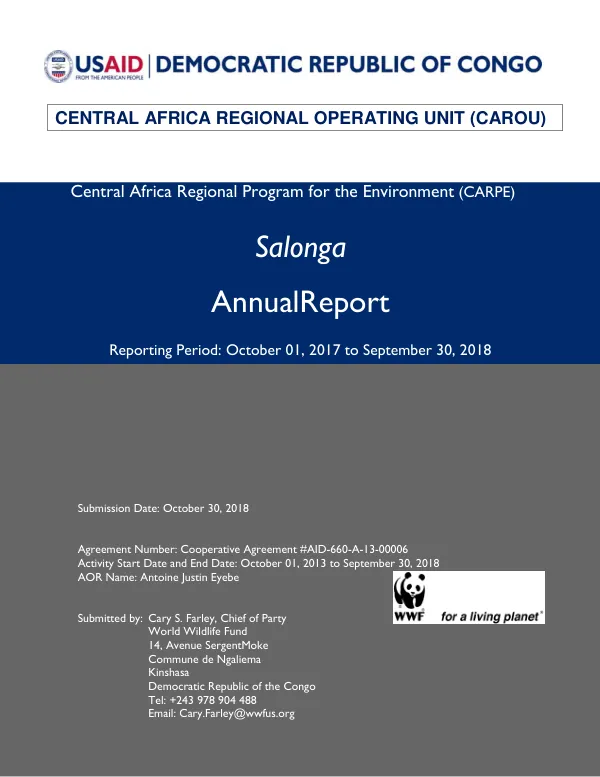
Annual Report: Central Africa Regional Program for the Environment (CARPE) 2017-2018
Sign inOXFAM INTERNATIONAL
Annual Report: Central Africa Regional Program for the Environment (CARPE) 2017-2018
The Central Africa Regional Program for the Environment (CARPE) is a project implemented by the World Wildlife Fund (WWF) and its consortium partners in the Salonga-Lukenie-Sankuru (MTKB) landscape in the Democratic Republic of the Congo (DRC).
2018 · 60 pages
Sign in to readA free account is required to download.
Abstract
The project is funded by the United States Agency for International Development (USAID) through its Central Africa Regional Program for the Environment (CARPE) and also supported by the Norwegian Government through the Norwegian Government's International Initiative on Climate and Forests (NICFI). The Salonga-Lukénie-Sankuru landscape (SLS) is a protected area that hosts the third largest protected area in the world, the Salonga National Park (SNP), which has been a World Heritage Site since 1984. The SLS landscape includes a forest ecosystem that is almost intact and is of wide ecological importance, with sources of 7 large rivers, a freshwater reservoir, and rich biodiversity including elephants and bonobos. Projections indicate that much of Central Africa's forests will be converted in the next 50 years, and the SNP could remain one of the last refuges for biodiversity and carbon sequestration. The CAFEC project has two major objectives: the sustainable management of target forest landscapes and the mitigation of threats to biodiversity. To achieve these goals, WWF shares implementation responsibilities with the Milwaukee Zoological Society (ZSM) and the Wildlife Conservation Society (WCS), as well as other significant partners such as OXFAM, the Max Planck Institute, and local NGOs. The project has also integrated into local and provincial policies by working closely with national institutions, including the Congolese Institute for Nature Conservation (ICCN), key ministries, and local government bodies. The project's interventions are based on 5 of the 8 strategies identified by the CAFEC project, including strengthening protected area management capacity, strengthening law enforcement and prosecution, and strengthening the implementation of Land Use Management Plans. The project has contributed to the patrols organized by the Salonga National Park Management Unit (UGPNS) through joint planning patrols with ICCN and evaluating their effectiveness. The project has also provided logistical support, including the supply of fuel, rations, and equipment, to increase the participation of ecoguards in wildlife surveys. In addition, the project has launched a series of biodiversity surveys, completing 83% of the planned transects in the corridor located between the two SNP blocks. These surveys have allowed updating the knowledge of the biological wealth of this corridor, highlighting key species in the northern block. The project has also estimated the carbon stock within the landscape, with WCS signing a Memorandum of Understanding (MoU) with the University of Leeds to provide carbon stock estimates of 17 ha of primary and secondary forest. The project has also made an appropriate contribution to the operation of 6 local schools and has built a school in Bokele. In Yaelima, 19 students, including 14 girls, were granted a scholarship to take courses. Although the program has focused on youth, adults have also benefited from educational assistance, with two adult literacy sessions organized. The project is continuing to explore innovative approaches to set up a community-based surveillance mechanism, with 124 individuals arrested during patrols, of which 42 were released after payment of fines or penal charges, and 3 cases sent to the courts.