AFRICAN WILDLIFE FOUNDATION
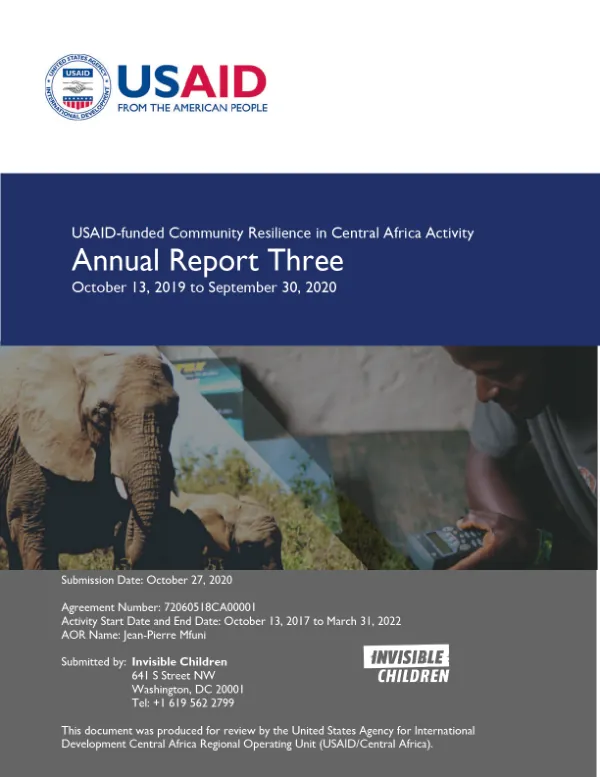
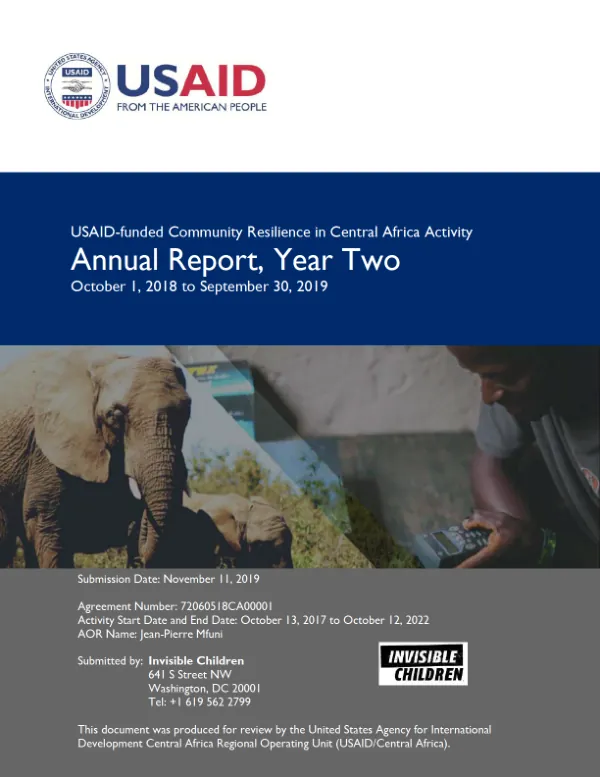
Annual Report: USAID-funded Community Resilience in Central Africa (CRCA)
The USAID-funded Community Resilience in Central Africa (CRCA) project began on October 13, 2017, and is set to conclude on October 12, 2022.
2019 · 77 pages
Sign in to readA free account is required to download.
Abstract
The project is implemented by Invisible Children (IC) and has several subcontractors, including African Parks (AP), African Wildlife Foundation (AWF), and Solidarité et Assistance Intégrale aux Personnes Démunies (SAIPED). The geographic coverage of the project spans Haut-Uele, Bas-Uele, and Nord Ubangui Provinces in the Democratic Republic of the Congo (DRC), as well as Mbomou, Haut-Mbomou, Haute Kotto, and Vakaga Préfectures in the Central African Republic (CAR). The CRCA technical approach is based on best practices developed by IC over eight years in the Mbomou-Uele border region. The project fosters inclusion and community-wide project ownership through a foundation-up approach to project formation, implementation, and management. This approach includes the involvement of women, pastoralists, and minority groups to improve the effectiveness of the community-focused Early Warning System (EWS). CRCA also strengthens community-to-community feedback loops by expanding the EWS to include monthly HF radio "analysis" calls, enabling communities to coordinate risk mitigation strategies more effectively. The project has several key interventions, including the management of an Early Warning System (EWS) and the training of Peace Committees to manage localized Community Action Plans (CAPs). Solidarité et Assistance Intégrale aux Personnes Démunies (SAIPED) supports the media component of CRCA, while Union d’Assistance aux Orphelins et Enfants Vulnérables (UAOEV) supports IR4. The project also empowers community groups to take collective action to address security and conservation threats. The CRCA project has made significant progress in promoting community resilience in Central Africa. The project has established a robust Early Warning System (EWS) that enables communities to coordinate risk mitigation strategies and respond to security and conservation threats. The project has also trained Peace Committees to manage localized Community Action Plans (CAPs), which has helped to improve community resilience and reduce conflict. The project has also made significant progress in promoting sustainable livelihoods and basic needs in target communities. The project has established a community-based approach to conservation and protection, which has helped to promote sustainable livelihoods and reduce poverty. The project has also provided support to vulnerable populations, including women and children, to help them recover from trauma and rebuild their lives. Overall, the CRCA project has made significant progress in promoting community resilience in Central Africa. The project has established a robust Early Warning System (EWS) and trained Peace Committees to manage localized Community Action Plans (CAPs). The project has also promoted sustainable livelihoods and basic needs in target communities and provided support to vulnerable populations.