DAI GLOBAL, LLC
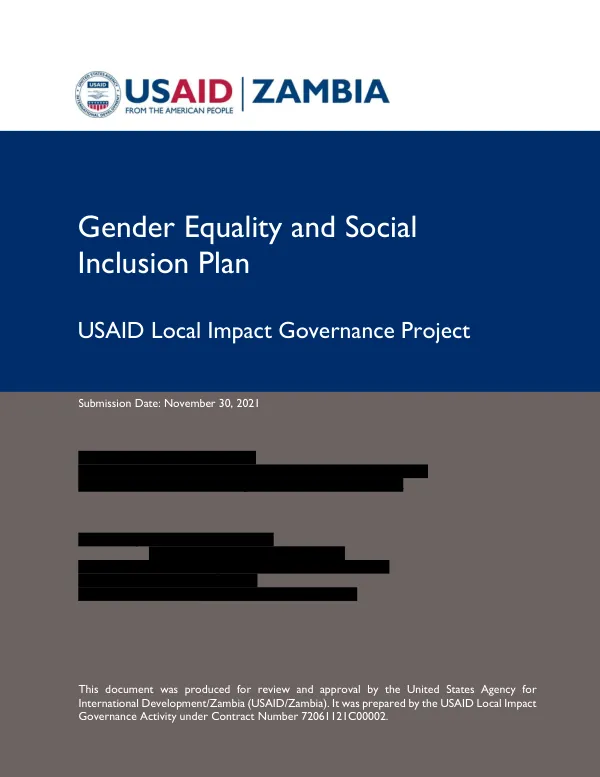
Local Impact GESI Plan
The Gender Equality and Social Inclusion (GESI) Plan is a comprehensive document outlining the USAID Local Impact Governance Project's approach to promoting gender equality and social inclusion in Zambia.
2021 · 110 pages
Sign in to readA free account is required to download.
Abstract
The plan was developed in collaboration with various stakeholders, including traditional leaders, community members, local authorities, civil society organizations, and local businesses. The plan aims to address unequal power relations between women and men and between different social groups, with a focus on rebalancing power relations and ensuring equal rights, opportunities, and respect for all individuals. The plan is guided by the 2020 USAID Gender Equality and Female Empowerment Policy, the 2016 U.S. Strategy to Prevent and Respond to Gender-Based Violence, the Government of the Republic of Zambia's 2018 Women's Entrepreneurship and Economic Empowerment Act, and the 2014 National Gender Policy. The plan identifies key definitions, including child marriage, customary law, gender, gender-based violence, and gender equality. Child marriage is defined as any formal marriage or informal union between a person under the age of 18 and an adult or another child. Customary law is defined as laws based on tradition and may be influenced by public opinion in a particular society about standards governing behavior or what society considers as a norm. The plan also highlights the importance of addressing gender-based violence, which is defined as any physical, mental, emotional, social, or economic abuse against a person because of that person's gender. The plan aims to promote gender equality, which is defined as the state or condition that affords women and men equal enjoyment of human rights, socially valued goods, opportunities, and resources. The plan outlines a comprehensive approach to promoting GESI, including the development of a GESI action plan, which will guide the project's activities and interventions. The plan also emphasizes the importance of monitoring and evaluation, which will be used to track progress and identify areas for improvement. The plan was developed by the Local Impact Technical Working Group, which consisted of experts from various fields, including collaboration, learning, and adaptive management, subnational capacity development, citizen engagement, gender and social inclusion, provincial management, monitoring, evaluation, and learning. The group worked closely with stakeholders to ensure that the plan is aligned with the needs and priorities of the communities and partners involved. The plan is expected to contribute to the achievement of the project's objectives, including promoting gender equality and social inclusion, improving the lives of women and girls, and enhancing the capacity of local authorities and civil society organizations to address GESI issues. The plan will also contribute to the achievement of the Sustainable Development Goals (SDGs), particularly Goal 5, which aims to achieve gender equality and empower all women and girls. The plan will be implemented over a period of time, with specific activities and interventions outlined in the GESI action plan. The plan will be monitored and evaluated regularly to track progress and identify areas for improvement. The plan will also be reviewed and updated regularly to ensure that it remains relevant and effective in promoting GESI in Zambia. The plan's success will depend on the effective implementation of its activities and interventions, as well as the commitment and support of stakeholders, including local authorities, civil society organizations, and local businesses. The plan's impact will be measured through the achievement of specific indicators and outcomes, including the reduction of gender-based violence, the increase in women's participation in decision-making, and the improvement in women's economic empowerment. Overall, the GESI Plan is a comprehensive and ambitious document that outlines the USAID Local Impact Governance Project's approach to promoting gender equality and social inclusion in Zambia. The plan is expected to contribute to the achievement of the project's objectives and the SDGs, and will be an important tool in promoting GESI in Zambia.
Related documents