GOVERNMENT OF THE REPUBLIC OF ZAMBIA
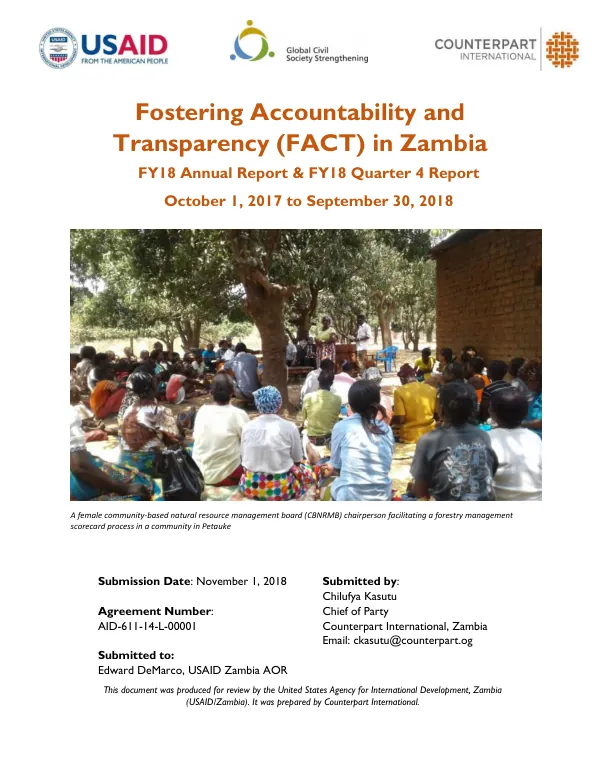
Fostering Accountability and Transparency (FACT) in Zambia
The Fostering Accountability and Transparency (FACT) program in Zambia aims to improve the enabling governance environment by increasing citizen demand for effective, transparent, and accountable service delivery.
2017 · 21 pages
Sign in to readA free account is required to download.
Abstract
The program, funded by the USAID Global Civil Society Leader with Associates Award, began on September 30, 2014, and will conclude on September 29, 2019. The program's goal is to strengthen the capacity of local Civil Society Organizations (CSOs) to enhance delivery and oversight of public service delivery in the education, health, HIV/AIDS, sustainable rural livelihoods, and environment sectors. The program activities fall within two objectives: Objective 1, which focuses on strengthening the capacity of local CSOs, and Objective 2, which aims to improve engagement between citizens and government service providers. The program is being implemented in a context affected by several government-led processes, including the NGO policy, the Access to Information (ATI) Bill, and the 7th National Development Plan (7NDP). These processes provide opportunities for citizen and civil society engagement and the possibility to improve service delivery. During the second quarter of FY17, several key activities were implemented, including a social accountability and advocacy training for all FACT partners, the administration of the community scorecard at Nampundwe Health Centre in Shibuyunji district, and a Roundtable meeting with government stakeholders in the Eastern Province. FACT also participated in trainings organized by Tetratech, World Vision, and the Forestry Department. The development of the NGO policy is a significant process that affects the context in which FACT is being implemented. The Ministry of Community Development and Social Welfare has completed consolidating inputs of stakeholders into the draft National NGO policy, which has been circulated to other ministries through cabinet for comments. The draft policy will set out various regulations that international and local NGOs should abide with, and will determine the operating environment for NGOs. The Access to Information Bill is another critical process that is being led by the Government of the Republic of Zambia. The Minister of Justice has stated that the bill is ready to be presented to Parliament, but the President's Press aide has contradicted this, stating that the bill requires constitutional amendments to be passed before it can be presented to Parliament. Open and transparent government, where citizens gain access to policies, information, and data, is key in holding duty bearers and service providers to account for their decisions and actions. The 7th National Development Plan (7NDP) provides the overall framework for Zambia's development for the period 2017-2021 and will be implemented based on an integrated multi-sectoral development approach. The Ministry of National Development Planning is developing an implementation plan that will utilize fiscal decentralization and devolution of powers as a way to promote a bottom-up approach to development. Civil Society for Poverty Reduction has been invited to be part of the technical working group for the plan, but it is unclear to what extent civil society will be given the opportunity to engage with the development of the implementation plan. The Government of the Republic of Zambia and the International Monetary Fund (IMF) have also been working together to address the country's economic challenges. A mission from the IMF concluded its visit to Zambia during the last quarter, and the government is working to implement the recommendations made by the IMF to address the country's economic challenges.