USAID DEC
Annual Program Performance Report for United States Agency for International Development, Office of U.S. Foreign Disaster Assistance
Sign inCONCERN WORLDWIDE INTERNATIONAL
Annual Program Performance Report for United States Agency for International Development, Office of U.S. Foreign Disaster Assistance
The Building a Better Response project, led by International Medical Corps, aims to strengthen the capacity of Non-Governmental Organization (NGO) personnel and other humanitarian actors to engage with the international humanitarian architecture.
2015 · 23 pages
Sign in to readA free account is required to download.
Abstract
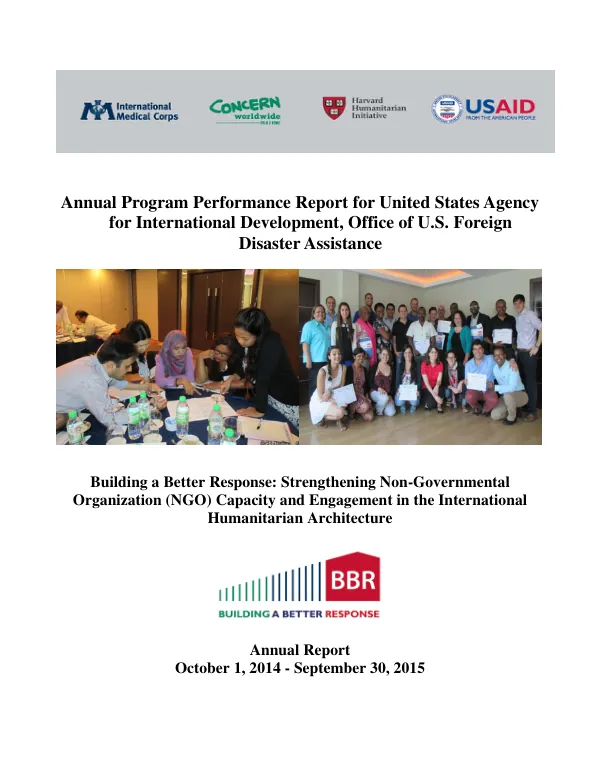
The project's goal is to improve overall coordination and response to the needs of beneficiaries through a consultative, multi-targeted training program. The project began implementation in February 2012, with a grant amount of $7,196,508.00 from the United States Agency for International Development's Office of U.S. Foreign Disaster Assistance. The project's timeline spans from February 24, 2012, to July 1, 2016. The program director is Angela Wiens, and the contact information is provided for International Medical Corps. The project's background is rooted in the Humanitarian Response Review launched by the UN Emergency Relief Coordinator in 2005. The review identified critical gaps and made recommendations to address them, including the strengthening of humanitarian leadership, partnerships between humanitarian actors, and the implementation of the "cluster approach" to foster greater predictability and accountability in international responses to humanitarian emergencies. The project's methodology involves a consultative process to engage end users in the development and dissemination of training tools. The content is intended to be comprehensive and practical, as well as accessible and flexible for various categories of humanitarian practitioners. The program includes the production and dissemination of training tools, such as e-learning units and workshops, to build the capacity of NGO staff and other humanitarian actors. The project's progress analysis indicates that the program has made significant strides in achieving its goal. The number of NGO staff members participating in consultation activities has increased, with a cumulative total of 451 participants in Year 3 and 1,438 participants in Year 4. The number of organizations coordinating has also increased, with a cumulative total of 469 organizations in Year 3 and 1,438 organizations in Year 4. The blended learning workshop curriculum was developed, successfully pilot tested, and implemented as a full workshop for the first time in Kuala Lumpur, Malaysia. The current reporting period saw the completion of eight more blended learning workshops that, with the e-learning, form the integrated learning series. The implementation of the first series of blended learning workshops started in September 2014 in Malaysia, and continued in the current reporting period. Workshops were conducted in Istanbul, Turkey; Dar es Salaam, Tanzania; and Dhaka, Bangladesh, with a total of 61 participants representing 35 different NGOs. The self-assessment for the first round of blended learning workshops indicates that participants felt their knowledge and readiness to engage increased during the course of the workshop. The percentages below indicate how much participants felt their knowledge and readiness to engage increased during the course of the workshop. The project's impact is evident in the increased participation of NGOs in coordination activities and the improved capacity of humanitarian actors to engage with the international humanitarian architecture. The project's success is a testament to the effectiveness of the consultative process and the integrated learning series in building the capacity of humanitarian actors. The project's geographic focus is on various countries around the world, including Malaysia, Turkey, Tanzania, Bangladesh, Ethiopia, Panama, Indonesia, and South Africa. The project's timeframes span from February 24, 2012, to July 1, 2016, with a grant amount of $7,196,508.00 from the United States Agency for International Development's Office of U.S. Foreign Disaster Assistance. The project's recommendations include the continued implementation of the integrated learning series and the expansion of the project's reach to more countries and humanitarian actors. The project's success has the potential to improve the overall coordination and response to the needs of beneficiaries in humanitarian emergencies.