CATHOLIC RELIEF SERVICES ORGANIZATION
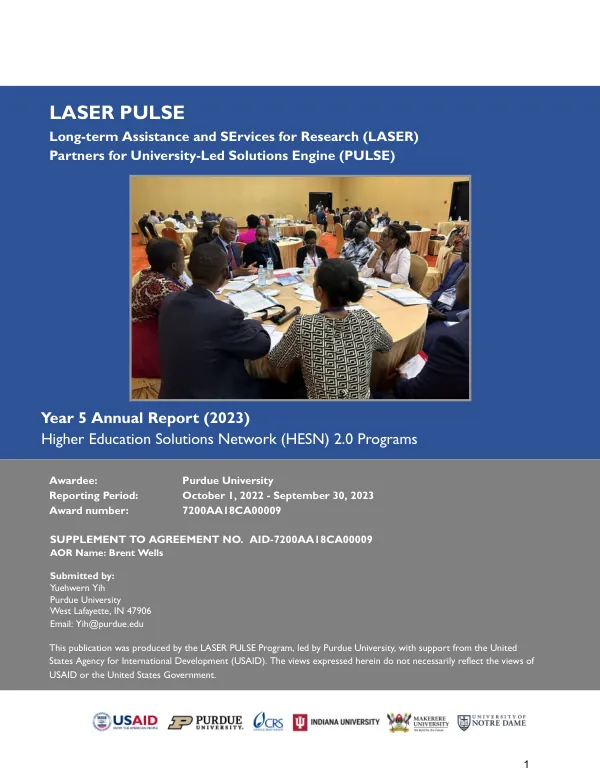
LASER PULSE FY23 (Year 5) Annual Report
LASER PULSE is a $70-million program that delivers research-driven solutions to field-sourced development challenges in USAID partner countries.
2023 · 58 pages
Sign in to readA free account is required to download.
Abstract
It is funded by USAID's Innovation, Technology, and Research (ITR) Hub, which leads USAID in original experimentation, using data and evidence in decision-making, harnessing scientific and technological advances, open innovation, and digital technology to transform development. LASER PULSE is executed through a consortium led by Purdue University, with core partners from Catholic Relief Services (CRS), Indiana University (IU), Makerere University in Uganda, and the University of Notre Dame (UND). It is implemented through a growing network of approximately 3,750 researchers and development practitioners in 86 countries. The program's objective is to enhance discovery and application in policy and practice of evidence-based solutions to development challenges. LASER PULSE's theory of change is that closer collaboration between academic researchers, development practitioners, policymakers, and donors results in new research that is readily translated into useful policies, products, and practices as evidence-based solutions to development challenges. To achieve its overarching objective, LASER PULSE's Results Framework lays out four Intermediate Results (IRs): IR 1, IR 2, IR 3, and IR 4. In September 2023, LASER PULSE leadership was invited by the National Science Foundation (NSF) to participate in an invite-only workshop on 'Enhancing America's Research Translation for Prosperity & Societal Impact.' This workshop was attended by around 60 participants from academic, government, industry, and foundation sectors, who discussed efficient strategies and models for bridging research and impact. During the workshop, LASER PULSE shared its Embedded Research Translation (ERT) model in group discussions and encouraged NSF leadership and other workshop participants to broaden their definitions of Research Translation beyond the existing considerations of technology transfer and commercialization. In August 2023, LASER PULSE received approval on its novation to Purdue Applied Research Institute (PARI). With this approval, LASER PULSE has begun its transition from Purdue University to PARI's Global Development and Innovation (GDI) division. In May 2023, LASER PULSE organized the 'USAID LASER PULSE Research for Development Learning Summit' to share the program's findings and lessons learned over the past five years. The Summit was attended by 60+ individuals from USAID, NGOs, the private sector, and the higher education sector. It took a format of multiple panel discussions where members from different sectors shared their experiences of utilizing LASER PULSE's ERT model and discussed how it benefited their work. In April 2023, LASER PULSE conducted a 'University Research Engagement and Capacity Strengthening Workshop' in Kampala, Uganda. The objective of the workshop was to strengthen the capacity of research administrators in Higher Education Institutions (HEIs) in sub-Saharan Africa and promote peer-to-peer learning on issues in the research ecosystem in HEIs in the region. The workshop was attended by 79 academic leaders from 11 sub-Saharan African countries, including DRC, Ethiopia, Ghana, Kenya, Rwanda, Somalia, South Africa, South Sudan, Tanzania, Uganda, and Zambia. In addition to strengthening the capacity of participants in the areas of research leadership and management, the workshop also provided a platform for participants to share their experiences and best practices in research administration. LASER PULSE's Results Framework (RF) (Appendix 1) lays out the four Intermediate Results (IRs) that the program aims to achieve. IR 1 focuses on increasing the delivery of collaborative and effective development-focused research. IR 2 aims to increase the synthesis, exchange, and translation of research results into usable development products and practices. IR 3 focuses on increasing the dissemination of translated research results for evidence-based solutions. IR 4 aims to ensure the sustainability of LASER PULSE approaches, activities, and targeted collaborations.