GOVERNMENT OF MEXICO
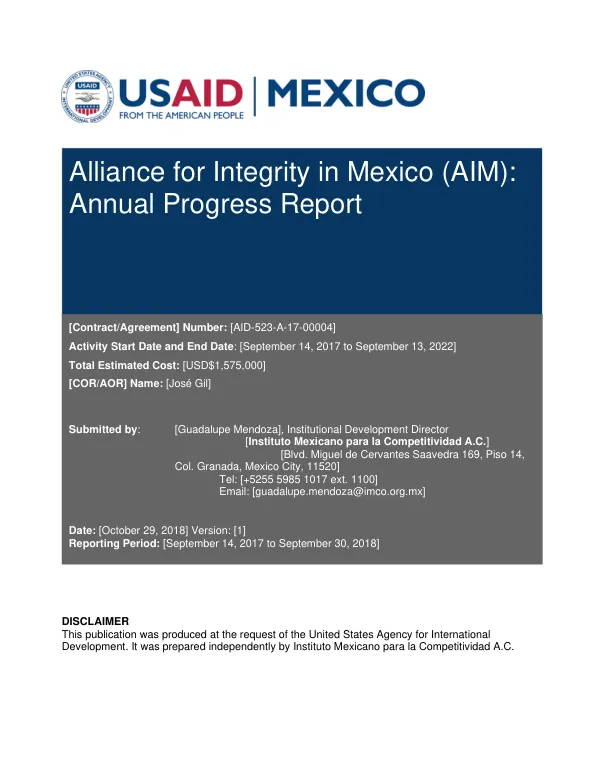
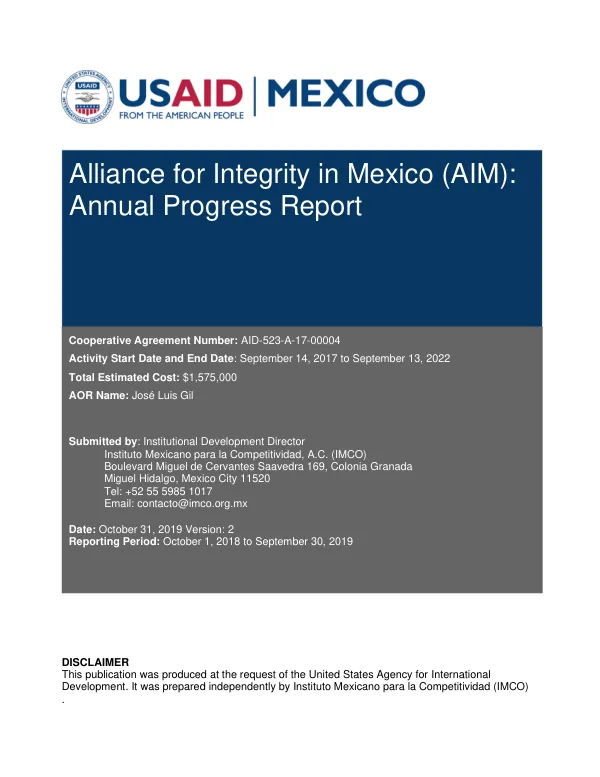
Annual Progress Report: Alliance for Integrity in Mexico (AIM)
The National Anticorruption System in Mexico began implementation in 2017 with the support of the United States Agency for International Development (USAID).
2019 · 14 pages
Sign in to readA free account is required to download.
Abstract
The system aimed to strengthen transparency, integrity, human rights, and the rule of law in Mexico. The initiative involved collaboration between the Government of Mexico (GOM), civil society, and the private sector. Component 1 of the initiative focused on anti-corruption and integrity. The activity involved developing a Model Business Integrity Policy and analyzing legal reform options for the proper sanctioning of cross-border bribery. The project objective was to support the GOM and civil society in implementing the new National Anticorruption System. The development of the Model Business Integrity Policy was a crucial aspect of this component, as it aimed to provide a framework for businesses to adopt integrity practices. The geographic scope of the initiative was national, with activities taking place in Mexico City and other regions. The day-to-day work and analysis were based at IMCO's facilities in Mexico City. The project involved collaboration with the GOM, the private sector, and civil society organizations, including the Mexican Business Council (Consejo Mexicano de Negocios, CMN). Component 2 of the initiative focused on access to justice and the rule of law. The activity aimed to provide greater amounts of data to strengthen the base of evidence for developing policy proposals that address challenges in human capital, legal reforms, institutional design, and materials. The project objective was to enhance legal certainty and security of investments, especially in cases of theft, fraud, bribery, and compliance with contractual clauses. The geographic scope of this component was also national, with activities taking place in Coahuila and other regions. The project involved collaboration with the Coahuila Attorney General's Office and the Autonomous University of Coahuila. IMCO completed the evaluation of 1168 criminal files by the end of September 2019, in collaboration with the Inter-American Academy of Human Rights (AIDH). Component 3 of the initiative focused on strengthening institutions to fight corruption and impunity. The activity aimed to develop a technical proposal outlining the key elements for the ideal institutional design of the Special Anticorruption Prosecutor's office at the state level. The goal was to provide recommendations that could be used by federal and state prosecutor offices, civil society groups, and others to support the GOM's National Anticorruption System implementation. The project involved three activities: report development on minimum institutional requirements for a functional Fiscalía Anticorrupción, outreach to key stakeholders, and provision of technical assistance to prosecutors. The report development activity was completed during the reported period, while the outreach activity was on hold due to a contract modification request. The technical assistance activity aimed to provide support to prosecutors who decided to diagnose and reform their Fiscalías Anticorrupción.
Related documents