FHI 360
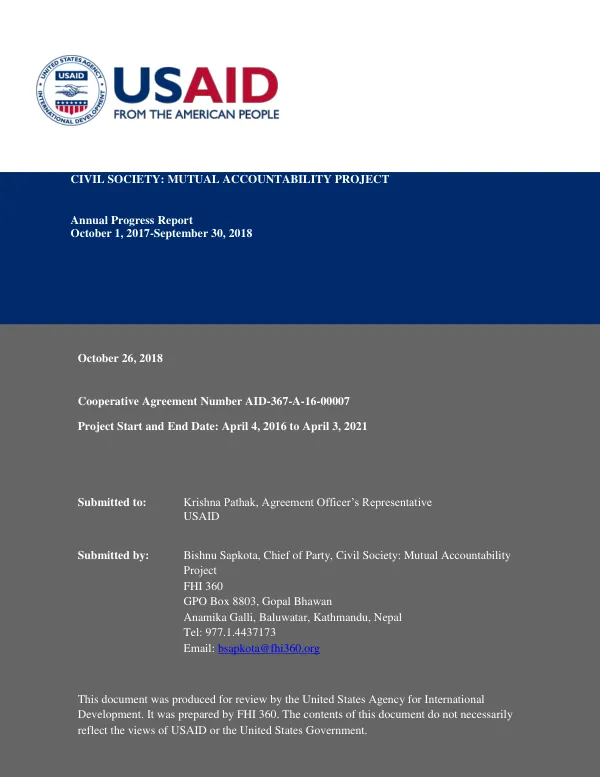
Annual Progress Report No. 3: Civil Society: Mutual Accountability Project
The Civil Society: Mutual Accountability Project (CS:MAP) is a USAID-funded initiative aimed at strengthening the enabling environment for civil society and media in Nepal.
2018 · 108 pages
Sign in to readA free account is required to download.
Abstract
The project operates under a cooperative agreement with FHI 360, with Bishnu Sapkota serving as the Chief of Party. The project's overall goal is to enhance the capacity of civil society organizations (CSOs) and media to effectively engage with the government and advocate for policy reforms. The project's progress is closely tied to Nepal's transition to federalism, which began with the holding of federal and provincial elections in November and December 2017. The formation of a new government in May 2018, led by Prime Minister KP Sharma Oli, marked a significant step in the operationalization of the 2015 Constitution of Nepal. The project's activities are designed to support the government's efforts to establish a new governance architecture that promotes inclusion and accountability. The project's progress is measured against four key objectives: (1) strengthening the enabling environment for civil society and media, (2) improving civil society and media capacity for effective policy advocacy and government engagement, (3) promoting more coordinated and effective civil society and media oversight of public resource use and public service delivery, and (4) strengthening organizational capacity and sustainability of CSOs working in USAID priority sectors. To achieve these objectives, the project has implemented a range of activities, including the development and submission of deliverables, progress achieved toward project objectives, and cross-cutting interventions such as gender equality and social inclusion, youth engagement, and the use of information, communication, and mobile technologies. The project has made significant progress in strengthening the capacity of CSOs and media to engage with the government and advocate for policy reforms. For example, the project has supported the development of a national advocacy strategy, which has helped to build a coalition of CSOs and media organizations working together to promote policy reforms. The project has also supported the establishment of a network of CSOs and media organizations working on issues related to social accountability, which has helped to promote transparency and accountability in government decision-making. In addition, the project has made progress in promoting more coordinated and effective civil society and media oversight of public resource use and public service delivery. For example, the project has supported the development of a public expenditure tracking system, which has helped to track government spending and identify areas where resources are being misallocated. The project has also supported the establishment of a network of CSOs and media organizations working on issues related to public service delivery, which has helped to promote accountability and transparency in government service delivery. The project has also made progress in strengthening the organizational capacity and sustainability of CSOs working in USAID priority sectors. For example, the project has supported the development of institutional improvement plans, which have helped to build the capacity of CSOs to engage with the government and advocate for policy reforms. The project has also supported the establishment of a network of CSOs working on issues related to social accountability, which has helped to promote transparency and accountability in government decision-making. Overall, the project has made significant progress in achieving its objectives and contributing to the strengthening of the enabling environment for civil society and media in Nepal. The project's activities have helped to promote transparency and accountability in government decision-making, and have supported the development of a more inclusive and participatory governance architecture.