FHI 360
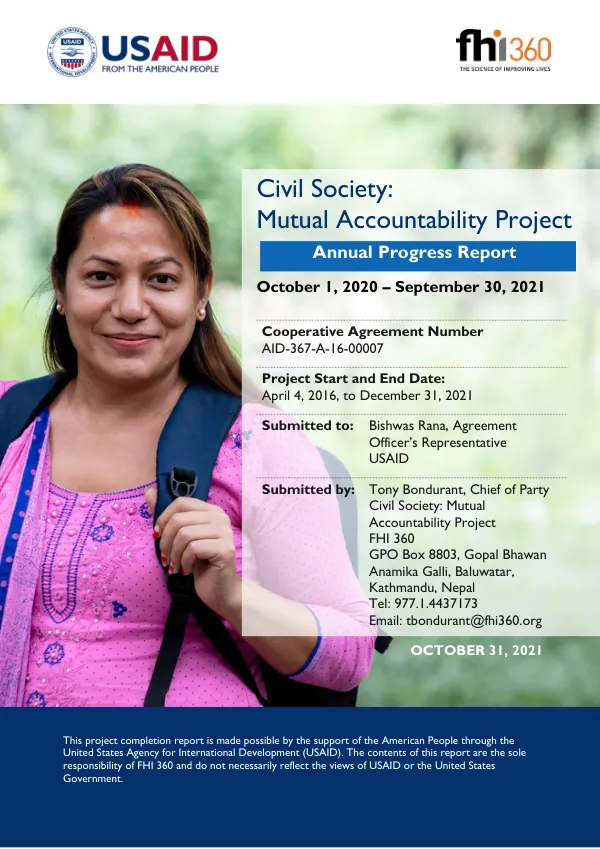
Annual Progress Report: Civil Society: Mutual Accountability Project (CS:MAP) Nepal
The Civil Society: Mutual Accountability Project (CS:MAP) in Nepal operated in a context dominated by the COVID-19 pandemic and political instability at federal and provincial levels during Fiscal Year 2021.
2021 · 54 pages
Sign in to readA free account is required to download.
Abstract
Despite these challenges, CS:MAP reported significant progress as it headed into the final year of implementation. CS:MAP supported civil society and media advocacy to improve bills registered in the Parliament, including the IT Bill 2018, the Media Council Bill 2019, and the Public Service Broadcasting Bill 2019. The project also helped local governments develop and implement civil society-related policies according to international standards and constitutional values. CS:MAP partners at national and subnational levels increased public participation in public policy-making processes. Throughout the year, civil society organizations (CSOs), media, and their coalitions supported raising the voice and problems of marginalized people and incorporating those in local government policies and programs. A CS:MAP partner held a series of dialogues inviting diverse group members such as women, Dalits, and marginalized communities to promote inclusive civic space. The project's coalition leads supported the development of a self-regulation framework for CSOs, which aimed to promote transparency, accountability, and good governance practices among CSOs. The framework was developed in consultation with CSOs, government agencies, and other stakeholders. CS:MAP also supported the establishment of a CSO coordination law, which aimed to promote coordination and collaboration among CSOs. CS:MAP partners at national and subnational levels conducted various activities to promote social accountability, including public hearings, social audits, and citizen engagement initiatives. These activities aimed to promote transparency, accountability, and good governance practices among government agencies and CSOs. The project's monitoring and evaluation framework was implemented to track progress and identify areas for improvement. The framework included indicators such as the number of CSOs that adopted the self-regulation framework, the number of local governments that developed and implemented civil society-related policies, and the level of public participation in public policy-making processes. CS:MAP's financial performance was in line with the project's budget, with a total expenditure of NPR 123.5 million (approximately USD 1 million) during FY 2021. The project's activity progress summary matrix showed that all project activities were implemented as planned, with some activities being completed ahead of schedule. The project faced several challenges during FY 2021, including the COVID-19 pandemic and political instability at federal and provincial levels. However, CS:MAP was able to mitigate these challenges through effective coordination and collaboration with its partners and stakeholders. The project's collaboration, learning, and adaptation framework was implemented to identify areas for improvement and develop strategies to address these challenges. Overall, CS:MAP made significant progress during FY 2021, despite the challenges posed by the COVID-19 pandemic and political instability. The project's achievements demonstrate its commitment to promoting transparency, accountability, and good governance practices among CSOs and government agencies in Nepal.