USAID DEC
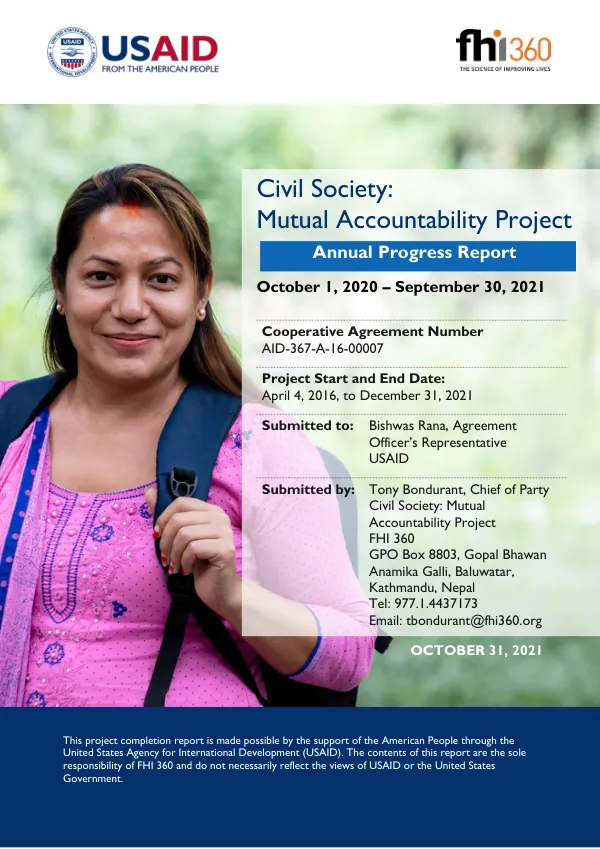
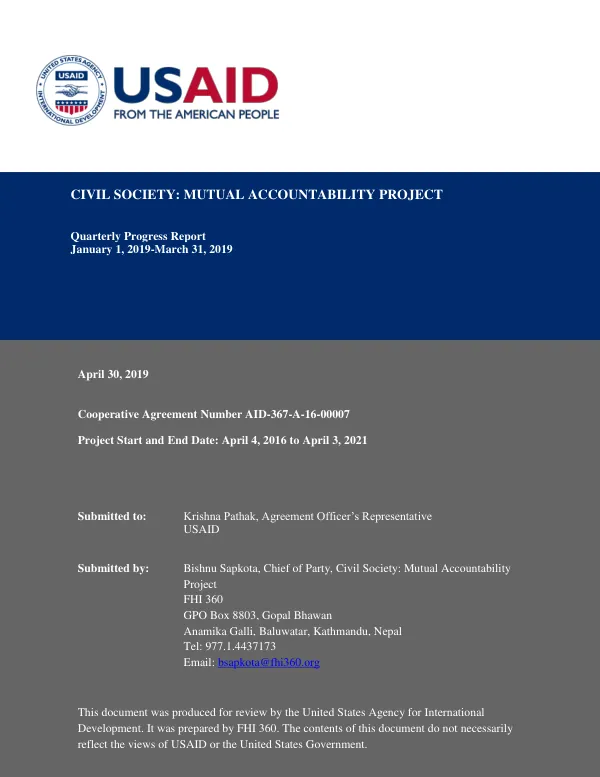
Civil Society: Mutual Accountability Project Quarterly Progress Report No. 9 Jan 1, 2019-Mar 31, 2019
Sign inFHI 360
Civil Society: Mutual Accountability Project Quarterly Progress Report No. 9 Jan 1, 2019-Mar 31, 2019
The federal Government of Nepal, formed pursuant to the September 2015 constitution, completed one year in office on February 15, 2019.
2019 · 100 pages
Sign in to readA free account is required to download.
Abstract
This marked the first time that the government was operational at three tiers, with the federal government sharing constitutionally-mandated powers with seven provincial governments and 753 local governments. The National Assembly, the Upper House in the Federal Parliament, unanimously passed the Province Public Service Commission (Bases and Criteria Determination) Bill–2075 B.S, on February 1, 2019. This legislation aimed to resolve confusion regarding roles and responsibilities to some extent. The Ministry of Federal Affairs and General Administration announced on March 28 that the process of integrating civil servants in all three levels—federal, provincial, and local—had been completed. Additionally, the Ministry of Law, Justice, and Parliamentary Affairs identified the need to review 174 laws in Nepal by March 4, 2019, to ensure consistency with the present constitution. The endorsement of two amendment bills—Bill to Amend Some Nepal Acts–Annex 1 and Bill to Amend Some Nepal Acts–Annex 2—supported this effort, with the former seeking changes in 56 Acts and the latter outlining revisions in 109 Acts to align them with the constitution. Concerns have been raised by civil society and media about the shrinking of civic space and media freedom. Reports of big corruption scams have challenged the government's commitment to fight corruption and improve transparency and accountability. During the reporting period, a bill was tabled in the parliament to address these concerns. The Civil Society: Mutual Accountability Project, in collaboration with various stakeholders, has been working to promote transparency and accountability in Nepal. The project has been engaging with government officials, civil society organizations, and media outlets to raise awareness about the importance of accountability and transparency. The project has also been supporting the development of a robust monitoring and evaluation system to track progress towards the government's commitments. The project has made significant progress in promoting transparency and accountability in Nepal. The project has conducted a series of training sessions for government officials and civil society organizations on the importance of transparency and accountability. The project has also developed a set of indicators to track progress towards the government's commitments. The project has also been working to promote the use of information and communication technologies (ICTs) to enhance transparency and accountability. The project has developed a mobile application to track government spending and has also been working with media outlets to promote the use of ICTs to enhance transparency and accountability. The project has also been engaging with the government to promote the use of open government data to enhance transparency and accountability. The project has been working with the government to develop a data portal that provides access to government data and has also been supporting the development of a data analytics platform to track progress towards the government's commitments. The project has also been working to promote the use of citizen engagement mechanisms to enhance transparency and accountability. The project has been supporting the development of a citizen engagement platform that allows citizens to track government spending and has also been working with civil society organizations to promote the use of citizen engagement mechanisms to enhance transparency and accountability. The project has also been working to promote the use of social accountability mechanisms to enhance transparency and accountability. The project has been supporting the development of a social accountability platform that allows citizens to track government spending and has also been working with civil society organizations to promote the use of social accountability mechanisms to enhance transparency and accountability. The project has also been working to promote the use of participatory budgeting to enhance transparency and accountability. The project has been supporting the development of a participatory budgeting platform that allows citizens to participate in the budgeting process and has also been working with civil society organizations to promote the use of participatory budgeting to enhance transparency and accountability. The project has also been working to promote the use of public financial management to enhance transparency and accountability. The project has been supporting the development of a public financial management system that allows citizens to track government spending and has also been working with civil society organizations to promote the use of public financial management to enhance transparency and accountability. The project has also been working to promote the use of results-based budgeting to enhance transparency and accountability. The project has been supporting the development of a results-based budgeting system that allows citizens to track government spending and has also been working with civil society organizations to promote the use of results-based budgeting to enhance transparency and accountability. The project has also been working to promote the use of performance-based budgeting to enhance transparency and accountability. The project has been supporting the development of a performance-based budgeting system that allows citizens to track government spending and has also been working with civil society organizations to promote the use of performance-based budgeting to enhance transparency and accountability. The project has also been working to promote