CENTER FOR EDUCATIONAL DEVELOPMENT
Annual Progress Report: Southern Sudan Interactive Radio Project
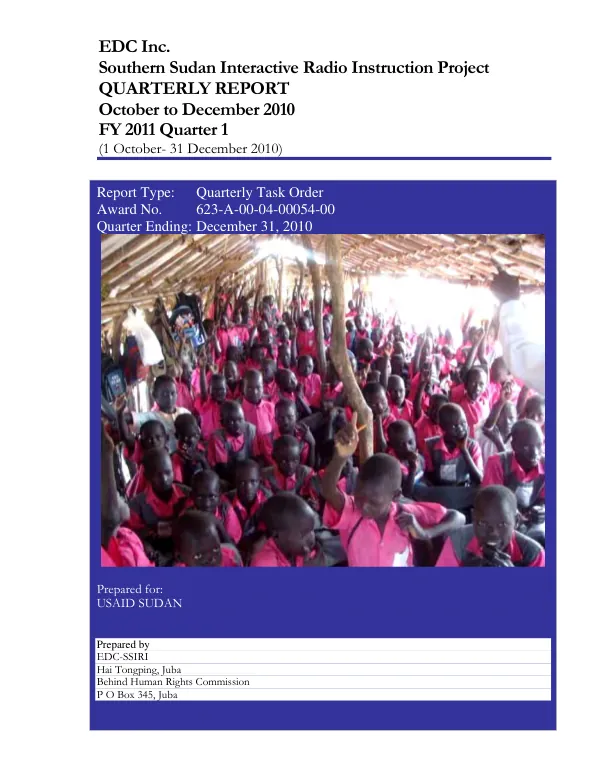
The Southern Sudan Interactive Radio Instruction (SSIRI) project is a collaborative effort between Education Development Center (EDC) and the Department of Alternative Education Systems in the Ministry of Education Science and Technology, Government of Southern Sudan.
2009 · 34 pages
Sign in to readA free account is required to download.
Abstract
The project's primary objective is to enhance the quality of education in Southern Sudan and the Three Areas through the strategic application of radio and other technologies for delivering high-quality educational content. The SSIRI project focuses on providing interactive radio instruction to students in primary schools, with a particular emphasis on improving literacy and numeracy skills. The project's approach involves the development and dissemination of educational materials, including teacher guides, facilitator guides, and audio materials, which are designed to be used in conjunction with radio broadcasts. The project also provides training and support to teachers and other education officials to ensure the effective implementation of the SSIRI program. In the first quarter of FY2011, the SSIRI project made significant progress in planning for the 2011 academic year. State review and planning meetings were held with Ministry of Education officials in all eight project states, resulting in the development of state work plans. The project also expanded its reach, with plans to introduce the SSIRI program to 14 new counties, bringing the total number of counties involved in the project to 40. The project's human resources office was busy recruiting staff for the new counties, with a total of 14 new staff appointed. The development of educational materials continued, with the preparation of teacher guides for Learning Village P1 to P3 incorporating new practice lessons, and the completion of the Facilitator's Guide for the new RABEA course, RABEA Intermediate. New CDs, including practice lessons for Learning Village and RABEA Intermediate, were prepared for FM radio stations, with agreements signed with 11 of the radio stations. IRI training was conducted at various locations, including Kotobi TTI in Western Equatoria and the two CECs in Eastern Equatoria. Basic computer training was provided for tutors at Arapi TTI, and the IT Officer assisted tutors with preparations for their lectures at Maridi TTI. The posttest for the P4 Learning Village evaluation was successfully completed in 12 counties, with 1243 learners being tested. The data was analyzed, and the report will be ready in the next quarter. The collection of data for the evaluation of RABEA Beginners was completed, and a draft report produced, which will be finalized in the coming quarter. The radio listenership survey was conducted in 14 counties, with survey teams interviewing 2,213 households to determine the number of individual listeners. The project's progress in the first quarter of FY2011 demonstrates its commitment to improving the quality of education in Southern Sudan and the Three Areas through the effective use of radio and other technologies.