USAID DEC
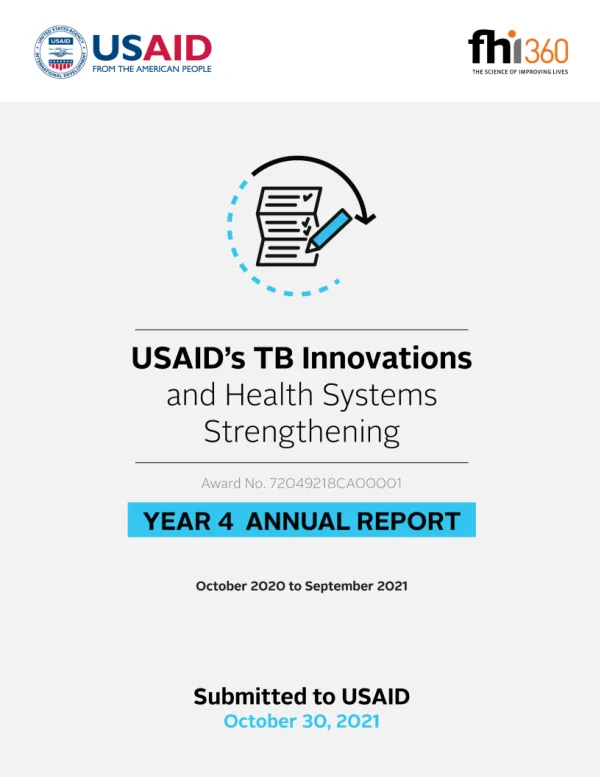
Annual Progress Report: TB Innovations and Health Systems Strengthening | Year 4 (Oct 2020 to Sep 2021)
Sign inFHI 360
Annual Progress Report: TB Innovations and Health Systems Strengthening | Year 4 (Oct 2020 to Sep 2021)
TB Innovations and Health Systems Strengthening began in 2018 with funding from the U.S.
2021 · 60 pages
Sign in to readA free account is required to download.
Abstract
Agency for International Development (USAID). The project aimed to strengthen health systems and improve tuberculosis (TB) control in the Philippines. Key objectives included increasing TB case detection, improving treatment outcomes, and enhancing health system capacity. Implementation focused on several high-impact interventions, including intensified case finding (ICF), active case finding (ACF), and TB-COVID-19 bidirectional case finding. The project also supported the development of a TB roadmap, which outlined key indicators for TB control, including reach, cure, and prevent TB. By the end of FY 2021, TB Roadmap indicators showed significant progress, with a 27% increase in TB case detection and a 25% increase in TB treatment success rates. The project also supported the implementation of the TB Platforms for Sustainable Detection, Care, and Treatment (TB Platforms) project, which aimed to improve TB diagnosis and treatment in the Philippines. TB Platforms implemented a public-private mix (PPM) approach, engaging private sector providers in TB care and treatment. By the end of FY 2021, TB Platforms had established partnerships with over 100 private sector providers, increasing access to TB diagnosis and treatment in underserved areas. In addition to TB control activities, the project also supported health system strengthening initiatives, including the development of a quality management system (QMS) for TB care and treatment. The project also supported the implementation of a TB information system, which provided real-time data on TB case detection, treatment outcomes, and other key indicators. The project also engaged with civil society organizations (CSOs) and the private sector to support TB control efforts. CSOs played a critical role in raising awareness about TB and promoting community-based TB care and treatment. The private sector contributed to TB control efforts through the provision of diagnostic services, treatment, and other essential commodities. By the end of FY 2021, the project had made significant progress in achieving its objectives, including increasing TB case detection, improving treatment outcomes, and enhancing health system capacity. The project's success was attributed to its collaborative approach, which engaged multiple stakeholders, including government agencies, CSOs, and the private sector. The project's achievements were reflected in several key indicators, including a 27% increase in TB case detection and a 25% increase in TB treatment success rates. The project also supported the development of a TB roadmap, which outlined key indicators for TB control, including reach, cure, and prevent TB. By the end of FY 2021, TB Roadmap indicators showed significant progress, with a 27% increase in TB case detection and a 25% increase in TB treatment success rates. The project's success also highlighted the importance of collaboration and coordination among stakeholders. The project's collaborative approach engaged multiple stakeholders, including government agencies, CSOs, and the private sector, to support TB control efforts. This approach helped to leverage resources, expertise, and capacity, ultimately contributing to the project's success. The project's achievements also underscored the importance of health system strengthening initiatives. The project's support for the development of a quality management system (QMS) for TB care and treatment helped to improve the quality of TB care and treatment in the Philippines. The project's support for the implementation of a TB information system also provided real-time data on TB case detection, treatment outcomes, and other key indicators, enabling more effective TB control efforts. Overall, the TB Innovations and Health Systems Strengthening project made significant progress in achieving its objectives, including increasing TB case detection, improving treatment outcomes, and enhancing health system capacity. The project's success was attributed to its collaborative approach, which engaged multiple stakeholders, including government agencies, CSOs, and the private sector.