FHI 360
SOP for ECG monitoring in the Management of Drug-resistant Tuberculosis
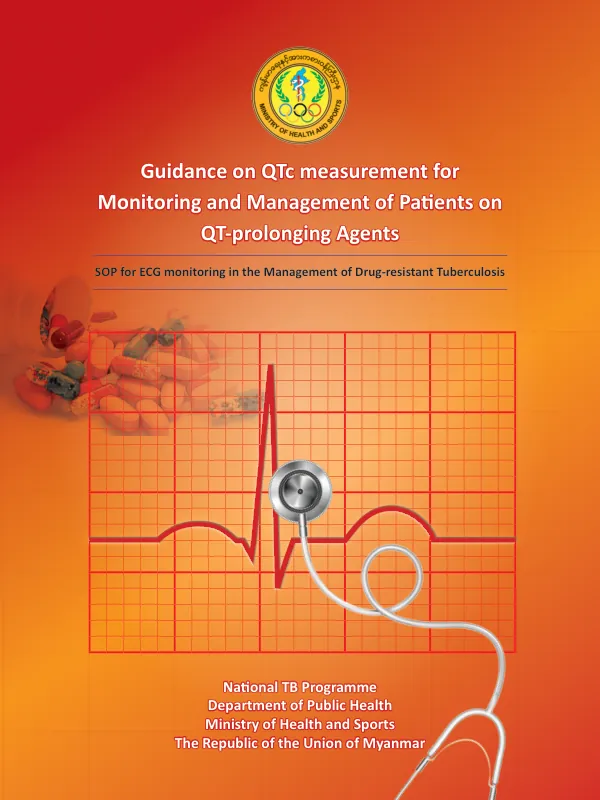
The National TB Programme of the Department of Public Health, Ministry of Health and Sports, The Republic of the Union of Myanmar, has developed a Standard Operating Procedure (SOP) for ECG monitoring in the management of drug-resistant tuberculosis (DR-TB).
2018 · 33 pages
Sign in to readA free account is required to download.
Abstract
The SOP aims to guide healthcare providers on the measurement of the corrected QT (QTc) interval from ECG monitoring of DR-TB patients treated with known QT-prolonging drugs. According to the Global Tuberculosis Report 2017, there were approximately 9,000 MDR/RR-TB cases among notified pulmonary TB cases in Myanmar in 2016. The use of new drug-resistant tuberculosis medicines, such as Bedaquiline (Bdq) and Delamanid (Dlm), has been approved by the World Health Organization (WHO) under certain conditions. However, these new and repurposed agents may prolong the QTc interval in the electrocardiogram (ECG), which can lead to life-threatening arrhythmias such as torsades de pointes (TdP). Therefore, baseline and follow-up ECG monitoring is recommended for patients started on TB treatment with QT-prolonging drugs. The SOP outlines the steps necessary to measure the QTc interval from ECG monitoring of DR-TB patients treated with known QT-prolonging drugs. The ECG is a non-invasive procedure that records the electrical activity of the heart over a period of time. The QT interval is the portion of the ECG that begins at the start of the QRS complex and ends at the end of the T wave. The QT interval is important because it expresses the time required for the ventricular myocardium to depolarize and repolarize, or the time it takes for the heart muscle to recharge between beats. The QT interval needs to be corrected because it shortens at faster heart rates and lengthens at slower heart rates. A correction formula is required to come up with a corrected QT or QTc, which estimates the QT interval at a heart rate of 60 beats per minute (bpm). This allows comparison of QT values over time at different heart rates. The SOP provides guidance on how to measure the uncorrected QT interval, measure the RR interval or heart rate, and determine the QTc. The SOP also outlines the action to be taken when the QTcF value is prolonged. Algorithm A is used for monitoring and managing QTcF prolongation among DR-TB patients when the QTcF is greater than 500 ms. Algorithm B is used for monitoring and managing QTcF prolongation among DR-TB patients when the QTcF is greater than or equal to 450 ms (male) or greater than or equal to 470 ms (female) but less than or equal to 500 ms. The development of this SOP was undertaken in 2017 and 2018 with the support from the USAID-funded Challenge TB Project, FHI 360. The National TB Programme would like to express its sincere thanks to Professor Nwe Nwe, Professor and Head, Department of Cardiology, University of Medicine 1, Yangon, Myanmar, for the technical support and time in the development of this SOP, and to Dr. Mamel Quelapio, Senior Consultant from KNCV Tuberculosis Foundation, for her technical support and guidance in the process of this SOP development.
Related documents