THE ASIA FOUNDATION
Annual Report 2 - FY 2017-2018 - GOI Version
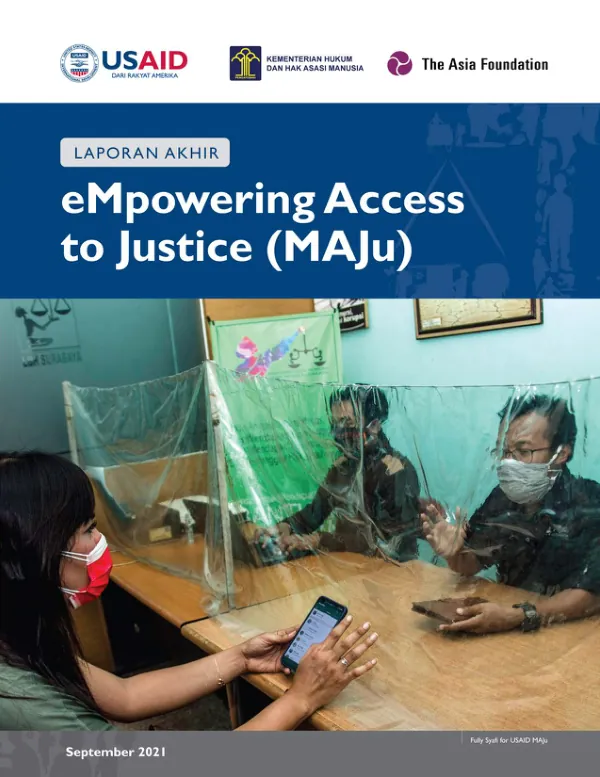
The eMpowering Access to Justice (MAJu) project aims to enhance the ability of marginalized citizens to access justice and the capacity of the Government of Indonesia (GOI) to protect their rights.
2018 · 77 pages
Sign in to readA free account is required to download.
Abstract
Indonesia's National Strategy on Access to Justice defines access to justice as a condition and process whereby the State guarantees the fulfillment of citizens' basic rights afforded by the 1945 Constitution and the 1948 Universal Declaration of Human Rights. The project partners with strategic legal aid and civil society organizations, as well as key GOI counterparts, focusing on four discrete target groups: religious and ethnic minorities, indigenous people, marginalized women, and other marginalized individuals. High levels of poverty in these groups are attributable to stigma and discrimination, and human rights abuses include, but are not limited to, gender-based violence, restrictions on freedoms of association and expression, the lack of legal identity, limited rights over land and natural resources, and discrimination against those receiving public resources. For individual marginalized communities, exclusion and discrimination are often fueled by religious groups that shape conservative political discourse. For indigenous communities, challenges arise when private sector business interests collide with forest-dependent communities. For women, deep-seated gender discrimination is a historical issue. The project seeks to address these challenges by improving the capacity of civil society organizations to protect the rights of marginalized citizens. This includes providing experiential learning and internships with universities, technical support for national non-governmental organizations, and promoting collaboration and cross-learning between legal aid organizations and civil society organizations. The project also aims to increase the number of legal aid organizations accredited to provide legal aid, strengthen the capacity of civil society organizations to develop applications and IT solutions, and develop the capacity of provincial universities to provide quality training and research services to legal aid providers and human rights defenders. To achieve these objectives, the project has established partnerships with key stakeholders, including the Government of Indonesia, civil society organizations, and private sector entities. The project has also developed a comprehensive monitoring and evaluation plan to track progress and identify areas for improvement. The plan includes indicators for measuring the project's impact on access to justice, human rights, and the capacity of civil society organizations. The project's geographic focus is on Indonesia, with a particular emphasis on the four target groups. The project's timeframes are from March 14, 2016, to March 13, 2021, with a total budget of US $10,000,000. The project has made significant progress in its first year, with over 2,500 farmers receiving training in sustainable agriculture techniques and demonstration plots showing yield improvements of 60% when applying recommended practices. The project's implementation is focused on three key outcomes: increased access to justice for poor and marginalized citizens, strengthened ability of the Government of Indonesia and state-auxiliary bodies to protect citizen rights via evidence-based decision making, and an improved enabling environment for civil society organizations to effectively promote protection of citizen rights. The project's activities are designed to address the root causes of human rights abuses and promote sustainable development in Indonesia. The project's monitoring and evaluation plan includes regular reporting and data collection to track progress and identify areas for improvement. The plan also includes a comprehensive assessment of the project's impact on access to justice, human rights, and the capacity of civil society organizations. The project's findings and recommendations will inform policy and programming decisions at the national and local levels, contributing to the development of a more just and equitable society in Indonesia. The project's geographic focus is on Indonesia, with a particular emphasis on the four target groups. The project's timeframes are from March 14, 2016, to March 13, 2021, with a total budget of US $10,000,000. The project has made significant progress in its first year, with over 2,
Related documents