THE ASIA FOUNDATION
Annual Report: eMpowering Access to Justice (MAJu) - FY 2019
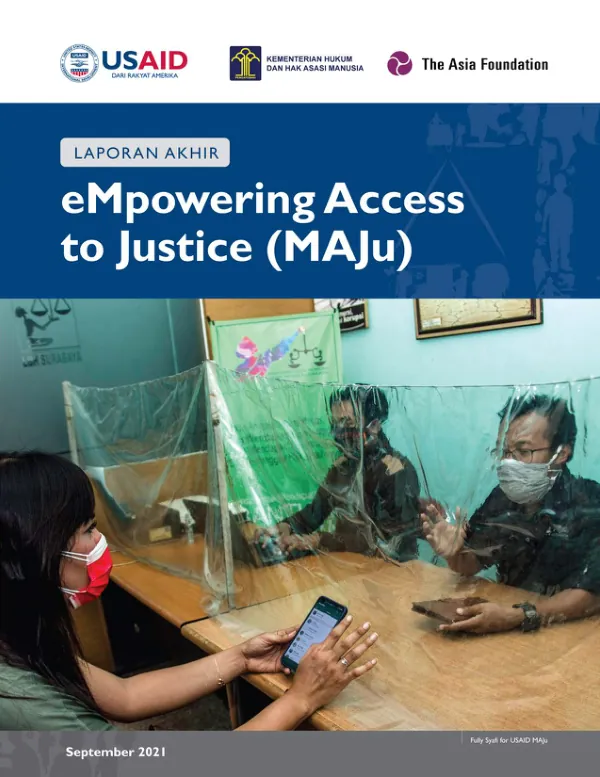
The eMpowering Access to Justice (MAJu) project aims to enhance the ability of marginalized citizens to access justice and the capacity of the Government of Indonesia (GOI) to protect their rights.
2019 · 131 pages
Sign in to readA free account is required to download.
Abstract
Indonesia's National Strategy on Access to Justice defines access to justice as a condition and process whereby the State guarantees the fulfillment of citizens' basic rights afforded by the 1945 Constitution and the 1948 Universal Declaration of Human Rights. Despite having an advanced regulatory framework to uphold human rights, Indonesia faces challenges in implementation. MAJu partners with strategic legal aid and civil society organizations, as well as key GOI counterparts, focusing on four discrete target groups: (1) religious and ethnic minorities (REM); (2) indigenous people; (3) marginalized women; and (4) other marginalized individuals. High levels of poverty in these groups are attributable to stigma and discrimination, and human rights abuses include, but are not limited to, gender-based violence, restrictions on freedoms of association and expression, the lack of legal identity, limited rights over land and natural resources, and discrimination against those receiving public resources. Data on human rights is scattered across multiple GOI agencies and ministries as well as across civil society organizations (CSOs), and therefore it is often inaccessible or unreliable. The quality and scope of human rights data vary by issue, with data stove-piped across various government institutions. Furthermore, the disparate management of data and access to it makes comprehensive analysis difficult and puts into question the integrity of the data. CSOs play a crucial role in promoting human rights and access to justice, providing crucial inputs to support policy development, and serving as watchdogs. However, their capacity is often stretched as they respond to a range of problems and challenges inherent to Indonesia's evolving democracy. For CSOs to operate effectively, they need better data, improved advocacy skills, and an environment that supports innovative thinking. CSOs also face constraints in their management capacities and lack access to stable funding, which limit the services they can provide to marginalized communities. The MAJu project seeks to address these challenges by increasing access to justice for poor and marginalized citizens, strengthening the ability of the Government of Indonesia and state-auxiliary bodies to protect citizen rights, and creating an improved enabling environment for civil society organizations to effectively promote protection of citizen rights. The project focuses on four outcomes: (1) increased access to justice for poor and marginalized citizens; (2) strengthened ability of the Government of Indonesia and state-auxiliary bodies to protect citizen rights; (3) improved enabling environment for civil society organizations; and (4) increased awareness of citizen rights within the Government of Indonesia, state-auxiliary bodies, and the private sector. The project partners with strategic legal aid and civil society organizations, as well as key GOI counterparts, to achieve these outcomes. The project also focuses on building the capacity of civil society organizations, improving data management and analysis, and promoting advocacy and public campaigns to address human rights issues. Through the United States Agency for International Development (USAID), MAJu has been well-vetted with central government counterparts, and this legitimacy is a major asset to the project. The Asia Foundation (TAF) has been working closely with USAID to ensure ongoing support from central government ministries responsible for access to justice and human rights. The project emphasizes the importance of integrating a strong gender perspective into its activities, considering the specific needs and challenges faced by marginalized women and other target groups. By addressing these challenges and promoting access to justice, the MAJu project aims to contribute to a more just and equitable society in Indonesia.