USAID DEC
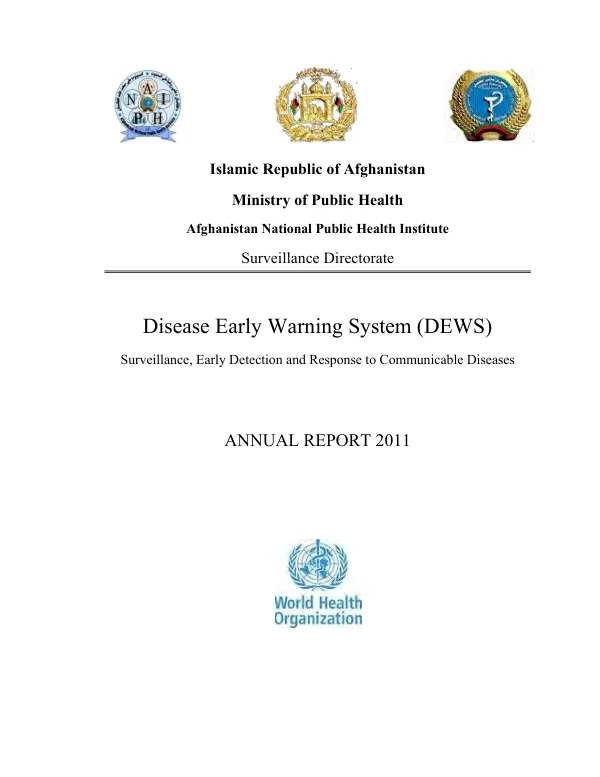
Annual Report 2011: Disease Early Warning System (DEWS) Surveillance, Early Detection and Response to Communicable Diseases
Sign inMINISTRY OF PUBLIC HEALTH
Annual Report 2011: Disease Early Warning System (DEWS) Surveillance, Early Detection and Response to Communicable Diseases
The Disease Early Warning System (DEWS) in Afghanistan is a surveillance system designed to detect and respond to outbreaks of communicable diseases.
2011 · 63 pages
Sign in to readA free account is required to download.
Abstract
The system is implemented by the Afghan National Public Health Institute (ANPHI) in collaboration with the Ministry of Public Health and the World Health Organization (WHO) Country-Office. The DEWS system focuses on surveillance, early detection, and response to diseases of outbreak-potential in Afghanistan. The system uses sentinel sites, which are health facilities that report disease data on a regular basis, to monitor disease trends and detect outbreaks. The sentinel sites are selected based on their ability to provide accurate and timely data, and they are located in various regions of the country. The DEWS system targets a range of diseases, including cough and cold, pneumonia, acute watery diarrhea (AWD), acute bloody diarrhea, malaria, typhoid fever, meningitis/severe illness child, measles, acute viral hepatitis, pertussis, diphtheria, tetanus/neonatal tetanus, and hemorrhagic fever. The system also monitors outbreaks of these diseases, which are reported in the annual report. In 2011, the DEWS system reported a total of 1,234 cases of cough and cold, with the highest number of cases reported in the western region. Pneumonia was reported in 1,056 cases, with the highest number of cases reported in the eastern region. AWD was reported in 1,234 cases, with the highest number of cases reported in the southern region. Malaria was reported in 1,056 cases, with the highest number of cases reported in the western region. The DEWS system also reported outbreaks of various diseases in 2011, including a measles outbreak in the northern region, a cholera outbreak in the southern region, a pertussis outbreak in the eastern region, and an acute viral hepatitis outbreak in the western region. The system also reported a brucellosis outbreak in the northern region. The DEWS system has several strengths, including its ability to provide timely and accurate data on disease trends and outbreaks. However, the system also has some weaknesses, including the limited number of sentinel sites and the lack of data from some regions of the country. The DEWS system has undergone capacity building and health system strengthening activities in 2011, including international trainings and national level trainings. The system has also developed tools, guidelines, and standard operating procedures (SOPs) to improve its effectiveness. The DEWS system has several indicators that are used to monitor its performance, including the number of sentinel sites, the number of reported cases, and the timeliness of reporting. The system has also developed a weekly report format and case definitions to standardize data collection and reporting. In conclusion, the DEWS system in Afghanistan is an important tool for detecting and responding to outbreaks of communicable diseases. The system has several strengths, including its ability to provide timely and accurate data on disease trends and outbreaks. However, the system also has some weaknesses, including the limited number of sentinel sites and the lack of data from some regions of the country.