GOVERNMENT OF BANGLADESH
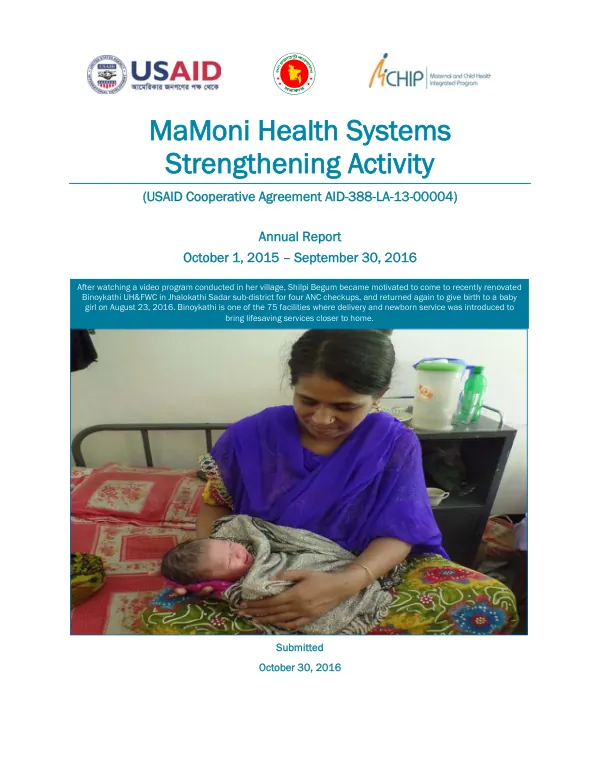
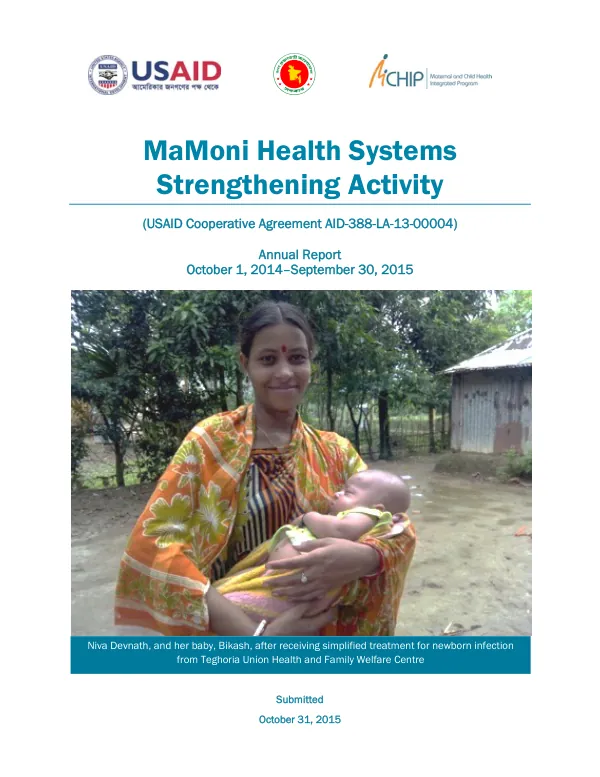
MaMoni Health Systems Strengthening Activity: Annual Report
The MaMoni Health Systems Strengthening Activity is a four-year project aimed at improving the utilization of integrated maternal, newborn, and child health, family planning, and nutrition (MNCH/FP/N) services in Bangladesh.
2015 · 70 pages
Sign in to readA free account is required to download.
Abstract
The project is supported by the United States Agency for International Development (USAID) and is implemented by the Jhpiego Corporation. The project's goal is to introduce and leverage support for the scale-up of evidence-based practices that have been applied and tested in Bangladesh. In year two of the project, the activities at the district level were revisited and scaled back in response to USAID's request for increased national level health systems strengthening (HSS) efforts. A two-pronged approach was designed, categorizing districts and upazilas into high-intensity intervention areas and health system capacity strengthening areas. The high-intensity areas aim to demonstrate best-practice models of MNCH/FP/N healthcare delivery through intensive support to the government of Bangladesh (GOB), while the health systems capacity strengthening areas focus on building the capacity of local health systems to deliver high-impact MNCH/FP/N services. The project identified 23 upazilas across five districts as high-intensity areas, with district saturation achieved in Habiganj, Lakshmipur, and Jhalokathi districts. In the Noakhali and Pirozpur districts, four and two upazilas were supported, respectively. The project's activities in these high-intensity areas include training of sub-assistant community medical officers (SACMOs) in comprehensive newborn care packages, improving service readiness through critical gap management, and strengthening health systems at the district level and below. The project also focuses on promoting an enabling environment to strengthen district-level health systems, identifying and reducing barriers to accessing health services, and improving the quality of care through quality assurance and quality improvement initiatives. The project's activities are designed to support the Ministry of Health and Family Welfare (MOH&FW) in introducing and leveraging support for the scale-up of evidence-based practices that have been applied and tested in Bangladesh. The project's intermediate results (IRs) for year two include improving service readiness through critical gap management, strengthening health systems at the district level and below, promoting an enabling environment to strengthen district-level health systems, and identifying and reducing barriers to accessing health services. The project's narrative report of major accomplishments highlights the successes achieved in these areas, including the training of SACMOs, the improvement of service readiness, and the strengthening of health systems. The project's challenges and solutions are also discussed in the report, highlighting the need for continued support and resources to sustain the project's activities and achieve its goals. The report concludes by emphasizing the importance of continued collaboration and partnership between the project, the government of Bangladesh, and other stakeholders to achieve the project's objectives and improve the health outcomes of the target population. The project's geographic focus is on the high-intensity areas, which include 23 upazilas across five districts in Bangladesh. The project's timeframes are from October 1, 2014, to September 30, 2015, with a focus on year two of the project. The project's recommendations include continued support for the government of Bangladesh to strengthen its health systems, increased resources for the project to sustain its activities, and continued collaboration and partnership between the project, the government, and other stakeholders. The project's implementation details include the training of SACMOs, the improvement of service readiness, and the strengthening of health systems. The project's methodologies include a two-pronged approach, categorizing districts and upazilas into high-intensity intervention areas and health system capacity strengthening areas. The project's key findings include the successes achieved in the high-intensity areas, including the training of SACMOs and the improvement of service readiness. The project's conclusions highlight the importance of continued support and resources to sustain the project's activities and achieve its goals. The project's recommendations include continued support for the government of Bangladesh to strengthen its health systems, increased resources for the project to sustain its activities, and continued collaboration and partnership between the project, the government, and other stakeholders.