USAID DEC
Annual Report 2012: Rehabilitation of Physically Disabled People in Developing Countries
Sign inUSAID
Annual Report 2012: Rehabilitation of Physically Disabled People in Developing Countries
The International Society for Prosthetics and Orthotics (ISPO) is a global organization that aims to facilitate the rehabilitation of physically disabled people in developing countries.
2012 · 12 pages
Sign in to readA free account is required to download.
Abstract
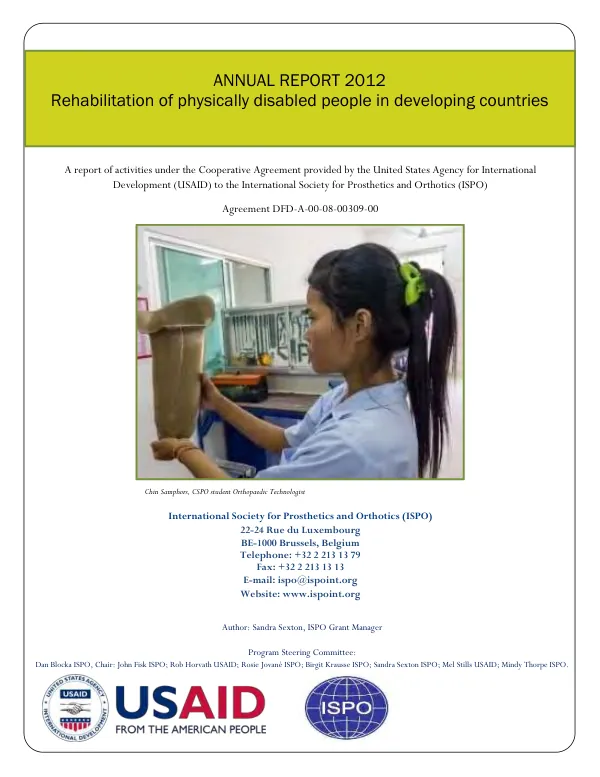
The organization has a collaborative agreement with the United States Agency for International Development (USAID] to support the development of prosthetic and orthotic services in these countries. The agreement, which was extended in July 2012, will enable ISPO to achieve its objectives within the new timescale. The organization has been able to continue to promote the scholarship program, which has seen a significant increase in interest, particularly in ISPO Category II scholarships. The program has awarded 96 scholarships to date, with a total of 113 scholarships planned for the original objective. The impact assessment of ISPO Category I and II graduates working in the field has been a key focus for the organization. In 2012, ISPO refined its methodology and conducted impact assessments in Tanzania, Kenya, and Uganda. The assessments highlighted the success of ISPO certified graduates in providing services for persons with physical disabilities, as well as the challenges faced in sustaining these services. ISPO has also explored the possibility of developing a joint guideline for prosthetic and orthotic services with the World Health Organization (WHO). The organization has been working with the WHO to develop a proposal for the guideline, which will be finalized in 2013. In addition to its work with USAID, ISPO has also promoted its collaborative agreement at the Orthopädie + Reha-Technik 2012 Trade Show and World Congress in Germany. The event provided an opportunity for ISPO to share information about its agreement with USAID and to network with other organizations in the field. The ISPO-USAID steering committee met on six occasions in 2012, including five virtual meetings and one face-to-face meeting. The committee visited Becker Orthopedic, a company that manufactures and distributes orthoses globally, and was impressed by the company's well-established protocols for orthoses manufacture and quality assurance system. ISPO has also been working to develop a new guideline for prosthetic and orthotic services. The guideline will be developed in collaboration with the WHO and will aim to provide a comprehensive framework for the development of prosthetic and orthotic services in developing countries. The organization has also been promoting its scholarship program, which has seen a significant increase in interest, particularly in ISPO Category II scholarships. The program has awarded 96 scholarships to date, with a total of 113 scholarships planned for the original objective. The organization has also been promoting its collaborative agreement with USAID, which has enabled ISPO to achieve its objectives within the new timescale. The agreement has also enabled ISPO to continue to promote the scholarship program and to conduct impact assessments in Tanzania, Kenya, and Uganda. In conclusion, ISPO has made significant progress in its efforts to facilitate the rehabilitation of physically disabled people in developing countries. The organization has been able to continue to promote the scholarship program, conduct impact assessments, and develop a new guideline for prosthetic and orthotic services.
Related documents