IDEAM
Annual Report 2021: SERVIR-Amazonia
The SERVIR-Amazonia Program is a collaborative initiative that aims to promote sustainable development in the Amazon region through the use of geospatial technologies and Earth observations.
2021 · 55 pages
Sign in to readA free account is required to download.
Abstract
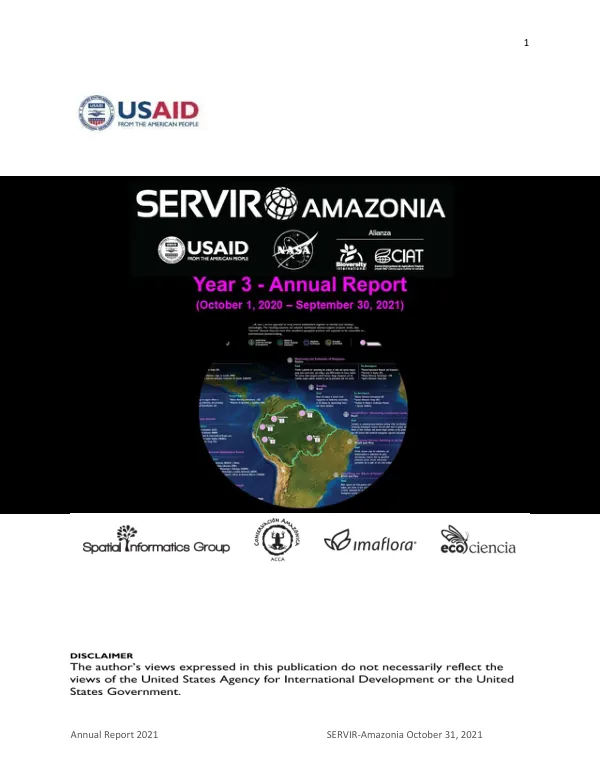
The program is led by a consortium of partners, including the United States Agency for International Development (USAID), the National Aeronautics and Space Administration (NASA), and various institutions from the Amazon region. During Year 3 of the program, significant advances were made in establishing a strong consortium and operational hub. A well-fitted team was capable of teleworking efficiently across the region, with good internal communication channels and professionalism. The program's commitments were met in a timely and successful manner, and coordination between program staff and institutions was smooth. The program's partner engagement activities in Year 3 were largely positive, with formalized partnerships established with institutions in Brazil, Peru, Ecuador, and Guyana. The work plans with main user institutions were consolidated, and partner engagement activities focused on structuring service teams, implementing work plans, and supporting service planning, design, and delivery. In Brazil, memoranda of understanding (MoUs) were signed with SEMAS-Pará, SEMA-Acre, FEMARH-Roraima, and Embrapa-CPATU, relating mainly to the work of the Applied Science Teams (AST). Other MoUs are in the final stages of negotiation with institutions such as Cemaden, Censipam, SEMA-Mato Grosso, and SEDAM-Rondônia. In Colombia, relations were strengthened with IDEAM, promoting the participation of its technicians in SERVIR-Amazonia training sessions, and holding technical meetings with the AST initiatives led by Jim Nelson and Douglas Morton. However, formalization of the partnership and organization of service teams is still pending. In Peru, MoUs were signed with SENAMHI, UTEC, UNALM, and FENAMAD, and a service team with SENAMHI was formed with regular meetings. Technical engagement meetings were held with the AST initiative led by Stephanie Spera and Naiara Pinto, especially with Alianza Cacao, CIMA, SERNANP, and MINAM. The program's services focus on various areas, including monitoring of gold mining in the Peruvian Amazon, TerraOnTrack: Increasing the Protection of Forests Managed by Community-Based Initiatives in the Brazilian Amazon, deforestation monitoring and reporting in Ecuador, and monitoring of gold mining in the Colombian Amazon. The program also provides services such as mapping soil fertility in Ecuador, monitoring and evaluation of mangroves in Guyana, and ecosystems services modeling in the Amazon's forest-agricultural interface. The program's main accomplishments during Year 3 are summarized in illustration 1, which highlights the program's progress in establishing a strong consortium, operational hub, and partner engagement activities. The program's services have been well-received by the target countries, and the program has made significant contributions to the sustainable development of the Amazon region. The program's cross-cutting themes include gender, indigenous peoples, sustainability, ecosystem of entrepreneurship, communications, capacity building, and program management. The program's monitoring, evaluation, and learning (MEL) activities are ongoing, and the program's communications activities have been successful in engaging stakeholders and promoting the program's services. The program's achievements are a testament to the collaborative efforts of its partners and the program's commitment to promoting sustainable development in the Amazon region. The program's continued success will depend on its ability to maintain a strong consortium, operational hub, and partner engagement activities, as well as its ability to adapt to the changing needs of the region.
Related documents