CHEMONICS
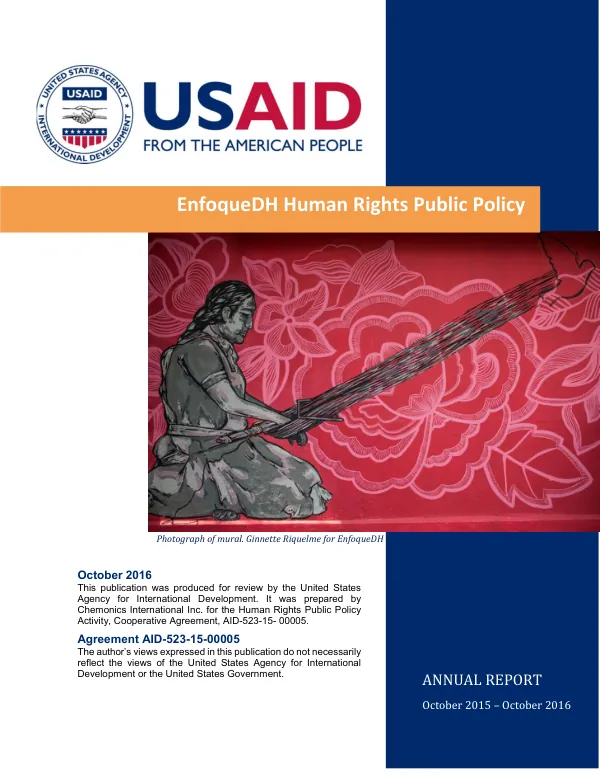
Annual Report: EnfoqueDH Human Rights Public Policy October 2015 – October 2016
The Human Rights Public Policy Activity, implemented by EnfoqueDH, began in October 2015 with the goal of supporting the government of Mexico (GOM) and civil society organizations (CSOs) in designing, implementing, and evaluating public policies with a human rights focus.
2016 · 28 pages
Sign in to readA free account is required to download.
Abstract
The Activity was funded by the United States Agency for International Development (USAID) and was managed by Chemonics International Inc. During the first year of implementation, EnfoqueDH made significant progress in establishing its reputation as a relevant actor on the Mexican human rights stage. The Activity mapped the needs, difficulties, and challenges facing the GOM and CSOs, as well as existing development initiatives in the field. EnfoqueDH also began building relations of cooperation and trust with the GOM, CSOs, and international foundations and cooperating agencies. The Activity established solid bases for the development of strategies and processes, signing six grants and implementing five activities with the national federal government, one with the state government of Nuevo León, and two with federal entities (Coahuila and Nuevo León). The Activity's emphasis changed from assisting the GOM in implementing the 2014-2018 National Human Rights Program to supporting the GOM and CSOs in designing, implementing, and evaluating public policies with a human rights focus. EnfoqueDH developed several strategies and activities to achieve its objectives. For objective 1 – Prevention of Human Rights Violations –, the Activity began a dialogue with a group of strategic partners from civil society to position the need for a public policy and a prevention mechanism in the human rights agenda. EnfoqueDH also initiated an analysis of institutional needs to regulate the use of force and design supervision and investigation methodologies for cases in which authorities use excessive force. Regarding objective 2 – Protection of Victims of Human Rights Violations –, EnfoqueDH contributed to law proposals to Preventing and Penalizing Enforced Disappearance of Persons, and to Preventing and Sanctioning Torture, as well as the General Law of Victims reform. The Activity also partnered with the National Commission for the Prevention and Eradication of Violence against Women to design a proposal for amending the General Law on Women's Access to a Violence-Free Life and relevant regulations related to the Warning System for Gender Violence against Women. In regards to objective 3 – Human Rights-Based Approach Incorporated into Public Policy –, EnfoqueDH provided technical support to the General Directorate of Human Rights Public Policy of the Human Rights Undersecretary of the Ministry of the Interior and supported initiatives to strengthen CSOs' advocacy skills. The Activity also coordinated the 2016 Tlaxcala Dialogue event, in partnership with the Universidad Autónoma de Tlaxcala, to identify common work areas in the topic of human rights amongst universities. Finally, regarding objective 4 – Evaluation of Human Rights Public Policies and Monitoring the Protection of Human Rights –, EnfoqueDH designed trainings to build the capacity of public officials to attend victims of human rights violations, ensuring that processes advance and non-revictimization is guaranteed. The Activity also supported the GOM in designing and implementing a national evaluation system for human rights public policies. EnfoqueDH's technical activities were focused on building relations of cooperation and trust with the GOM, CSOs, and international foundations and cooperating agencies. The Activity also established solid bases for the development of strategies and processes, signing six grants and implementing several activities with the GOM, CSOs, and federal entities. The Activity's expansion to include a fifth objective – strengthening the technical capacities of public servants and CSOs to advance in the search for truth, justice, and reparations – was approved at the end of the first year, with a budget increase of US $3,188,037. Activities under this component will begin in year 2.