USAID
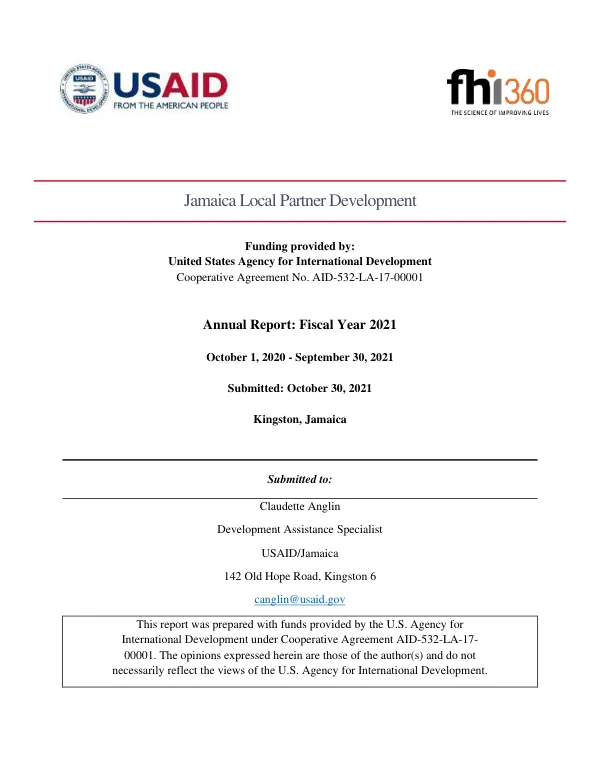
Annual Report: Fiscal Year 2021
Local Partner Development (LPD) is a program funded by the United States Agency for International Development (USAID) under the Caribbean Basin Security Initiative (CBSI).
2021 · 89 pages
Sign in to readA free account is required to download.
Abstract
The program aims to tackle youth crime and violence through secondary and tertiary prevention initiatives. LPD's work focuses on strengthening Jamaican institutions to advance collaborative, evidence-based youth crime and violence prevention strategies. LPD has three components. Component 1 activities strengthen the efforts of civil society organizations (CSOs) that work on youth crime and violence prevention. This is achieved by providing training and resources to enable CSOs to become more effective actors in providing sustainable services that positively impact youth crime and violence in Jamaica. Crime prevention efforts that involve civil society and key community stakeholders working together have greater legitimacy and public confidence, making them more effective. Component 2 activities build the capacity of private sector organizations to effectively support secondary and tertiary youth crime prevention. This involves involving the private sector in strategic efforts to prevent and reduce youth crime and violence. By engaging the private sector, LPD aims to leverage their resources and expertise to support crime prevention initiatives. Component 3 activities engage Government of Jamaica (GOJ) institutions that directly support targeted CSOs. This component aims to increase the capacity of GOJ institutions to implement evidence-based secondary and tertiary crime prevention strategies. LPD also works to create an enabling environment for CSOs to advance crime and violence prevention initiatives. Implementation progress was made in all three components during Fiscal Year 2021. Component 1 activities resulted in the training of over 2,500 CSO staff and volunteers in youth crime and violence prevention. Component 2 activities led to the formation of private sector partnerships with CSOs and government institutions to implement secondary and tertiary crime prevention initiatives. Component 3 activities increased the capacity of GOJ institutions to implement evidence-based crime prevention strategies. Despite progress, implementation challenges were encountered, particularly related to the COVID-19 pandemic. General implementation challenges also affected the program's progress. Lessons learned from these challenges will inform future program implementation. The program's monitoring and evaluation framework is designed to track progress towards its objectives. Key performance indicators (KPIs) are used to measure the program's impact and effectiveness. The program's financial management is also subject to regular review and audit to ensure compliance with USAID regulations. LPD's work has contributed to improved outcomes in youth crime and violence prevention in Jamaica. The program's focus on building partnerships and leveraging resources has helped to increase the effectiveness of crime prevention efforts. As the program continues to implement its activities, it is expected to make further progress towards its objectives.
Related documents