CREATIVE ASSOCIATES INTERNATIONAL INC.
Annual Report FY2020: Mali Peacebuilding, Stabilization and Reconciliation
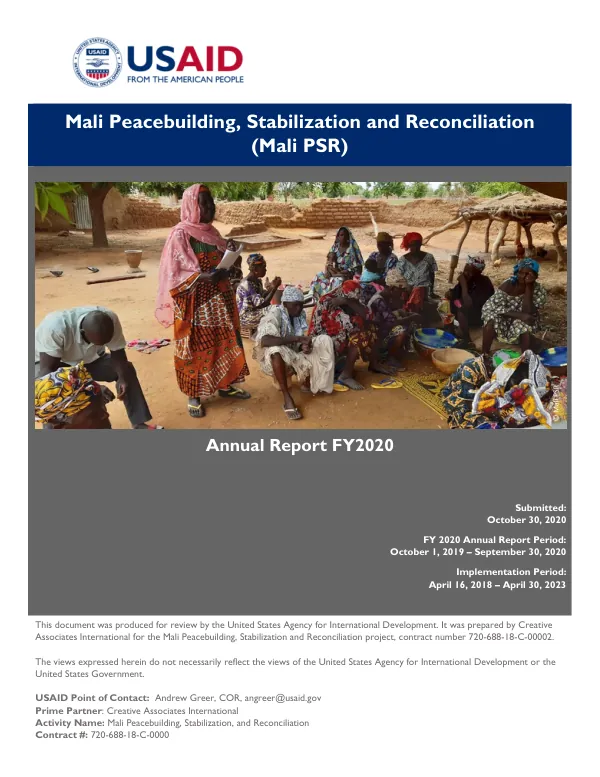
Mali Peacebuilding, Stabilization, and Reconciliation (Mali PSR) made progress toward its goals of fostering trust and good governance in communities and helping partner communes lay paths toward peace and stability.
2020 · 72 pages
Sign in to readA free account is required to download.
Abstract
Despite a tumultuous year, Mali PSR saw a steady increase in the number of communes classified as buffer or resilient as many communities moved away from ongoing active conflict. This shift enabled Mali PSR to expand and deepen programming in previously high-risk locations and build on initial program and donor investments in stabilization and peacebuilding. Foundational Activities were designed to help communities, government officials, and international donors better understand the intersection between local conflict and governance system legitimacy. ICAF-FRAMe analyses and the resulting Path to Resilience report laid bare trust deficits, grievances, and the impact of government weaknesses and absence, key factors in Mali's persistent instability and ongoing local conflicts. Mali PSR disseminated assessment findings broadly and presented findings to US Embassy and USAID senior officials, USAID Implementing Partners, regional and local authorities during three roundtables in Segou, Timbuktu, and Gao, and to members of the Community Engagement Committees in 40 communes. In partner communes, Mali PSR worked closely with community members to understand and validate the results, incorporate findings into ongoing commune-level grievance plans, and use the information to develop commune-specific programming. Objective 1 focused on trust building and capacity building for actors in local conflict prevention and resolution and supported community efforts to resolve local grievances. Conflict prevention and management trainings deepened the skills of those already involved in conflict resolution and expanded the number of community members trained and willing to contribute to conflict prevention and resolution. Mali PSR also mapped information and communication flows in communities to build on alert and response mechanisms already in place. This mapping will support the Year 3 piloting of Early Warning and Response Systems (EWRS) in select communities. ICAF-FRAMe analyses established that communities across the country see women as important peacebuilders and that youth need to be engaged in and forward conflict resolution. Based on those findings, Mali PSR launched the #1Mali1Peace initiative, awarding more than 20 grants to youth and women-led organizations to bring different ethnic and demographic groups together for joint activities promoting social cohesion through sports, civic education, and cultural events. Objective 2 aimed to strengthen inclusive governance and civic engagement in conflict-affected communities. Mali PSR supported the development of Community Engagement Committees in 40 communes, which helped to build trust and foster dialogue between community members and local authorities. The committees also facilitated the implementation of commune-level grievance plans and supported the development of Early Warning and Response Systems (EWRS) in select communities. Additionally, Mali PSR worked with local authorities to strengthen the capacity of Community-Based Organizations (CBOs) and Civil Society Organizations (CSOs) to engage in conflict prevention and resolution efforts. Objective 3 focused on empowering youth and building their resilience to violent extremism. Mali PSR supported the development of youth-led initiatives and organizations, which helped to promote social cohesion and prevent radicalization. The #1Mali1Peace initiative, launched under Objective 1, also contributed to this objective by engaging youth in peacebuilding efforts and promoting social cohesion through sports, civic education, and cultural events. Furthermore, Mali PSR worked with local authorities to develop and implement programs that addressed the root causes of youth radicalization, such as poverty, unemployment, and lack of opportunities. Objective 4 aimed to mitigate the impact of COVID-19 and associated second-order effects on Malian communities. Mali PSR worked with local authorities and partners to develop and implement programs that addressed the social and economic impacts of the pandemic, such as food insecurity, economic disruption, and increased vulnerability to violent extremism. The programs included cash transfer programs, food assistance, and economic empowerment initiatives, which helped to support vulnerable communities and promote resilience. Key challenges faced by Mali PSR during FY2020 included the COVID-19 pandemic, which disrupted programming and created new challenges for communities and partners. Additionally, Mali PSR faced challenges related to security, governance, and conflict, which required the program to adapt and respond to changing circumstances. Despite these challenges, Mali PSR made significant progress toward its objectives and achieved key outcomes and results, including the expansion of programming in previously high-risk locations, the development of Early Warning and Response Systems (EWRS) in select communities, and the empowerment of youth and women in peacebuilding efforts.