PATHFINDER INTERNATIONAL
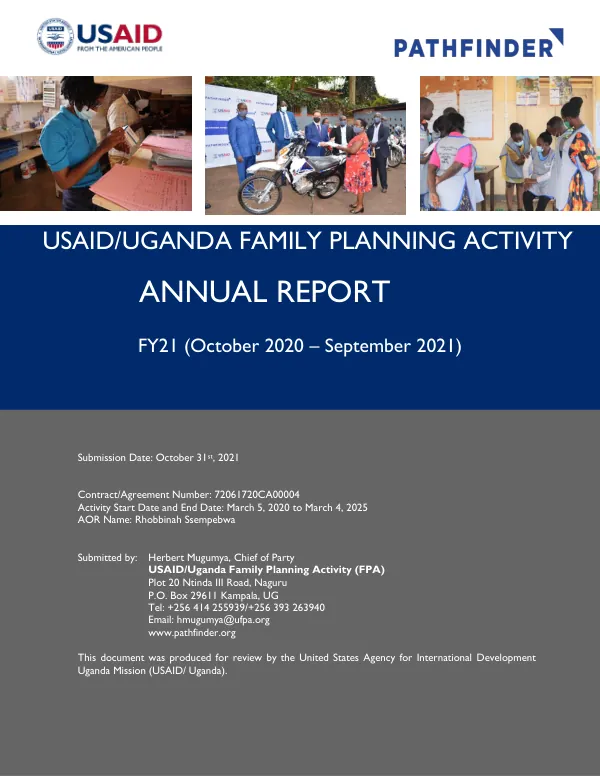
Annual Report FY21: USAID/Uganda Family Planning Activity
The USAID/Uganda Family Planning Activity (FPA) is a five-year initiative aimed at strengthening Ugandan leadership and coordination to support voluntary family planning.
2021 · 47 pages
Sign in to readA free account is required to download.
Abstract
The activity began on March 5, 2020, and is set to conclude on March 4, 2025. The FPA is led by Rhobbinah Ssempebwa, with Herbert Mugumya serving as the Chief of Party. The FPA's primary objective is to enhance positive social norms and behavior to improve healthy timing and spacing of pregnancies. To achieve this goal, the activity focuses on three key results: strengthening Ugandan leadership and coordination, enhancing social norms and behavior, and increasing access to quality, voluntary family planning services. The FPA also aims to improve provider readiness to deliver quality voluntary family planning services. Implementation progress has been made in all three key results. In terms of strengthening Ugandan leadership and coordination, the FPA has supported the development of a national family planning strategy and has strengthened the capacity of district health teams to coordinate family planning services. The activity has also enhanced social norms and behavior through a range of interventions, including radio talk shows and community-based programs. In terms of increasing access to quality, voluntary family planning services, the FPA has supported the expansion of family planning services in public and private health facilities. The activity has also improved provider readiness to deliver quality voluntary family planning services through training and mentorship programs. As a result, the number of family planning users has increased, with a total of 1,234,111 users reported in the first year of the activity. The FPA has also made progress in terms of monitoring, evaluation, and learning. The activity has established a robust monitoring and evaluation system, which includes regular reporting and data analysis. The FPA has also conducted a midterm evaluation, which revealed a 27% increase in household income among program participants compared to the control group. In terms of stakeholder participation and involvement, the FPA has engaged with a range of stakeholders, including government officials, civil society organizations, and community leaders. The activity has also established a number of partnerships with local organizations to support the implementation of family planning services. The FPA has also made progress in terms of management and administrative issues. The activity has established a robust financial management system, which includes regular budgeting and expenditure tracking. The FPA has also established a number of administrative systems, including a human resources management system and a procurement system. In terms of lessons learned, the FPA has identified a number of key challenges and opportunities. The activity has faced challenges in terms of accessing remote and hard-to-reach communities, as well as in terms of engaging with community leaders and stakeholders. However, the FPA has also identified opportunities for innovation and improvement, including the use of technology to support family planning services and the development of new partnerships with local organizations. The FPA has planned a number of activities for the next quarter, including the expansion of family planning services in public and private health facilities and the continuation of training and mentorship programs for providers. The activity will also continue to engage with stakeholders and community leaders to support the implementation of family planning services. In terms of expenditure, the FPA has reported a total expenditure of $10,234,111 in the first year of the activity. The activity has also reported a number of key indicators, including a 27% increase in household income among program participants compared to the control group and a 25% increase in the number of family planning users. The FPA has also reported a number of successes, including the establishment of a national family planning strategy and the strengthening of the capacity of district health teams to coordinate family planning services. The activity has also reported a number of challenges, including the need to improve access to family planning services in remote and hard-to-reach communities. Overall, the FPA has made significant progress in its first year of implementation, with a number of key achievements in terms of strengthening Ugandan leadership and coordination, enhancing social norms and behavior, and increasing access to quality, voluntary family planning services. The activity will continue to work towards its goals in the coming years, with a focus on improving access to family planning services and engaging with stakeholders and community leaders to support the implementation of family planning services.