ABT ASSOCIATES
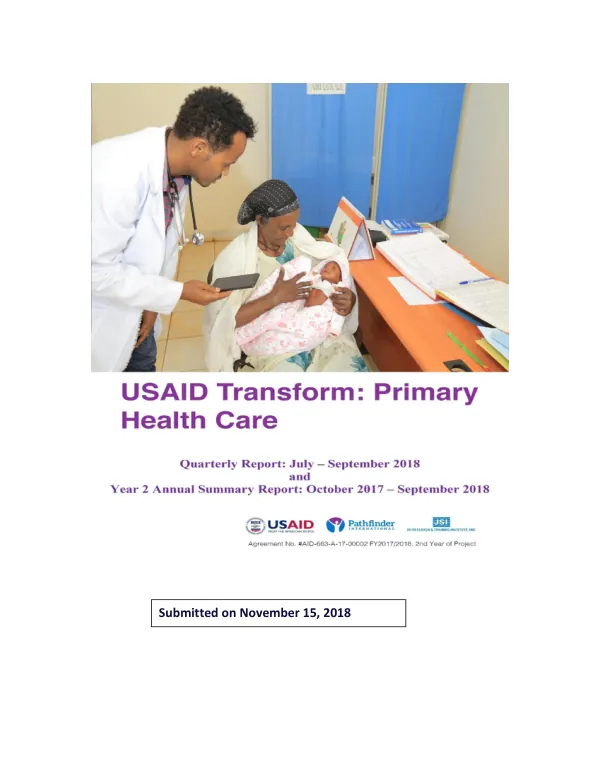
Annual Report: Transform: Primary Health Care
Transform: Primary Health Care is a USAID-funded project aimed at contributing to the prevention of child and maternal deaths (PCMD) in Ethiopia.
2018 · 129 pages
Sign in to readA free account is required to download.
Abstract
The project supports the implementation of the Health Sector Transformation Plan (HSTP) of the Government of Ethiopia (GOE) through phased, adaptive technical assistance (TA). The project's overall success is measured by the achievement of four high-level results: improved management and performance of health systems, increased sustainable quality of service delivery across the PHCU's continuum of care, improved household and community health practices and health-seeking behaviors, and enhanced program learning to impact policy and programming related to PCMD. The project focuses primarily on maternal, newborn, and child health (MNCH); family planning (FP); reproductive health (RH); and malaria within Ethiopia's four major regions of Amhara, Oromia, Southern Nations, Nationalities, and Peoples' Region (SNNPR), and Tigray. The project provides integrated support to health facilities to enhance access and the quality of health services. The project's performance is measured by annual PMP indicators, which are provided in the Annex. In FY2018, the project achieved significant results in improving management and performance of health systems. The percentage of health centers with high performance (>=85%) as measured by the Ethiopian Health Center Reform Implementation Guideline (EHCRIG) score for the recent quarter was 79.9%, exceeding the planned target of 10.0%. The percentage of woredas utilizing performance improvement fund and liquidating within the timeframe was 94.7%, meeting the planned target of 75.0%. The project also achieved significant results in increasing sustainable quality of service delivery across the PHCU's continuum of care. The couples years of protection (CYP)-all methods indicator showed a significant increase, with 6,970,000 CYP achieved, exceeding the planned target of 6,500,000. The project also made significant progress in improving household and community health practices and health-seeking behaviors. The percentage of supported health centers that have women representatives among the board was 105.5%, exceeding the planned target of 77.0%. The project also achieved significant results in enhancing program learning to impact policy and programming related to PCMD. The project's technical assistance and capacity building activities contributed to the development of the Health Sector Transformation Plan (HSTP) and the implementation of the Health Center Reform Implementation Guideline (EHCRIG). The project faced several challenges in FY2018, including delays in the implementation of the Health Center Reform Implementation Guideline (EHCRIG) and the Health Sector Transformation Plan (HSTP). However, the project's technical assistance and capacity building activities helped to address these challenges and ensure the project's overall success. The project's major tasks for the next quarter include finalizing the implementation of the Health Center Reform Implementation Guideline (EHCRIG) and the Health Sector Transformation Plan (HSTP), and continuing to provide technical assistance and capacity building activities to support the project's overall success. The project's performance is measured by annual PMP indicators, which are provided in the Annex. The project's achievements in FY2018 demonstrate its commitment to improving management and performance of health systems, increasing sustainable quality of service delivery across the PHCU's continuum of care, improving household and community health practices and health-seeking behaviors, and enhancing program learning to impact policy and programming related to PCMD. The project's continued success will depend on its ability to address the challenges it faced in FY2018 and to continue providing technical assistance and capacity building activities to support the project's overall success.