USAID DEC
Family Planning High Impact Practices Can Improve Outcomes for Population, Health, and Environment Programs
Sign inJSI
Family Planning High Impact Practices Can Improve Outcomes for Population, Health, and Environment Programs
Family Planning High Impact Practices (HIPs) are a set of evidence-based practices developed by international family planning researchers and program experts to improve family planning and reproductive health program outcomes.
2018 · 4 pages
Sign in to readA free account is required to download.
Abstract
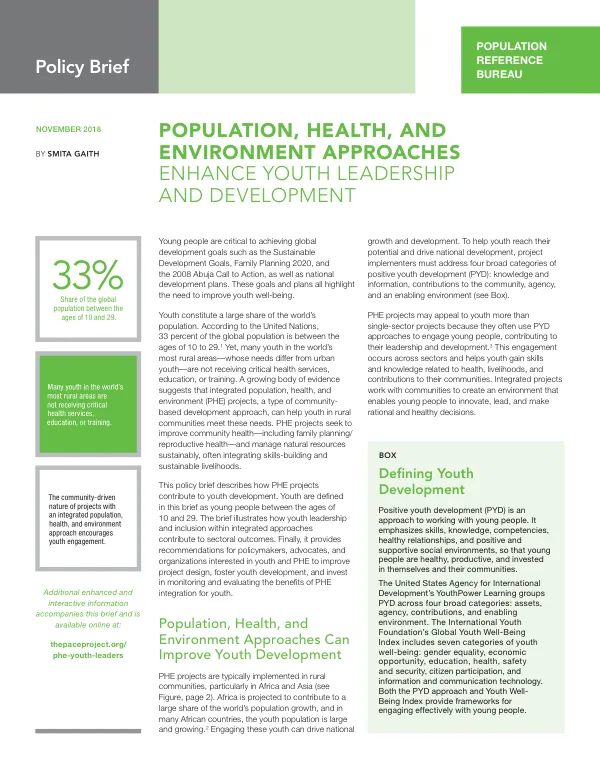
HIPs are organized into three categories: Enabling Environment, Service Delivery, and Social and Behavior Change. Each HIP is documented in an easy-to-use brief and has a corresponding suite of resources and tools that can be easily adapted to individual projects. PHE projects, which are integrated community-based projects that reach populations in ecologically rich areas with activities that improve reproductive and other health services and support the sustainable use of natural resources, can direct their family planning resources more effectively to achieve greater impact when they use HIPs. Strengthening the awareness of and knowledge base between HIPs and PHE projects allows for the sharing of family planning best practices. Using HIPs in remote areas also feeds information back to the HIPs evidence base to show how PHE projects help serve the family planning needs of rural communities. Many PHE projects already implement activities that align with elements of select HIPs, even if the activities are not identified as or deliberately tied to HIPs. For example, the Mahefa Miaraka project in Madagascar supports the public health sector to manage a network of community health volunteers as part of a government plan to reduce maternal, child, and newborn mortality and morbidity. PHE projects could contribute to the growing HIPs evidence base by measuring and reporting HIP results, benefiting the PHE and family planning communities. To strengthen their family planning activities' impact, PHE projects should strategically consider how to leverage High Impact Practices (HIPs). PHE projects should also improve measuring and reporting on any and all use of HIPs. PHE projects' use of HIPs present a unique learning opportunity for the family planning community because the projects serve remote communities where family planning services are often not accessible. For example, the Health of People and Environment in the Lake Victoria Basin (HoPE-LVB) project found that over four years, contraceptive use in project areas increased, on average, by six times in Kenya and three times in Uganda. The Tuungane PHE project, led by Pathfinder International and The Nature Conservancy in 24 remote villages beside Lake Tanganyika in western Tanzania, aims to improve access to reproductive health services while also assisting community members to better manage natural resources to ensure their livelihoods are sustainable and their community is healthy. An extensive review of Tuungane reports and correspondence with project staff identified components of the project that use elements of HIPs. The project found that although access to and use of contraception has increased in the project area, desired family size has not changed. Increasing knowledge about comprehensive reproductive health services and facilitating dialogues about optimal birth spacing for family health and prosperity could help community norms evolve.
Related documents