CONDESAN
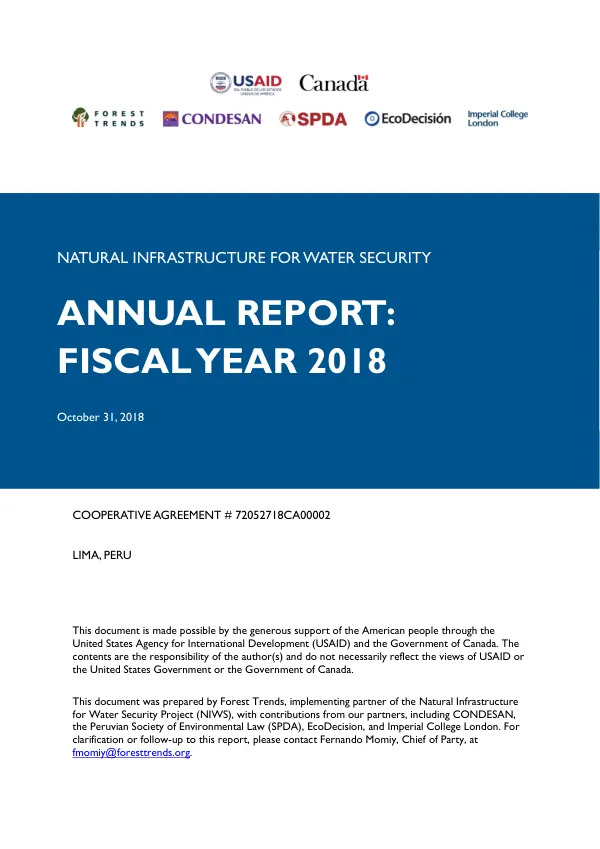
Annual Report: Natural Infrastructure for Water Security (FY2018)
The Natural Infrastructure for Water Security Project (NIWS) is a collaborative effort between Forest Trends and its partners, including CONDESAN, the Peruvian Society of Environmental Law (SPDA), EcoDecision, and Imperial College London.
2018 · 68 pages
Sign in to readA free account is required to download.
Abstract
The project aims to enhance public and political awareness of the benefits of natural infrastructure for water security and to facilitate and scale investments in natural infrastructure. NIWS made significant progress in the first nine months of the project, establishing foundational relationships and coordination platforms at national, watershed, and local levels. The project refined and communicated its strategy for facilitating and scaling investments in natural infrastructure, and made important advances in priority technical areas, including capacity-building, informing decisions on natural infrastructure, and unblocking bottlenecks for natural infrastructure investment. One of the key objectives of NIWS is to create an enabling environment for natural infrastructure. The project achieved this by enhancing public and political awareness of the benefits of natural infrastructure for water security, as well as the role of the project itself. NIWS developed a communications strategy, which included the creation of short videos, an infographic, press releases, and quarterly newsletters, to disseminate key messages to target audiences. The project also trained journalists to cover natural infrastructure, and published assessments of candidate platforms and hosted electoral breakfasts with candidates in NIWS priority regions. NIWS also increased attention on natural infrastructure through direct engagement of decision-makers in priority sectors. The project established its Advisory Board with high-level representatives from key sectors, including the Ministry of Environment, the National Superintendent of Sanitation Services, and the National Water Authority. NIWS renewed the political commitment of Advisory Board members to work with the project and across sectors to scale-up natural infrastructure, and secured the commitment of the Ministry of Women and Vulnerable Populations and the Ministry of Energy and Mines to work collaboratively with NIWS and their public counterparts. Another key objective of NIWS is to improve information management for decision-making on natural infrastructure. The project invested in strategically orienting its efforts through the identification of over 25 priority decision-makers with a direct influence on designing and scaling effective natural infrastructure. NIWS convened a broad group of researchers and information users to kick off efforts around a shared research agenda for natural infrastructure, and developed an analysis contributing to the research agenda, a decision matrix, and a performance-based framework for natural infrastructure. NIWS also established working relationships at the regional and local levels with watershed councils, regional governments, water utilities and regulators, technical experts, and civil society in NIWS priority watersheds. The project conducted rapid assessments to provide a comprehensive view of the state of biophysical, hydrological, social, institutional, and political aspects of natural infrastructure strategies in priority watersheds. NIWS selected four learning sites, including Samanga, Piuray, Chalhuanca, and Huamantanga, and began to apply the Open Standards for the Practice of Conservation methodology to inform performance-based, gender-sensitive design of natural infrastructure interventions. In addition to these efforts, NIWS worked closely with water users, regional governments, and public investment experts to begin to mobilize investments in natural infrastructure. At the end of the fiscal year, NIWS is directly supporting 4 public investment projects in the pre-investment phase, representing a total investment budget of USD 4.2 million; indirectly, NIWS is facilitating investment mobilization for a further USD 21.8 million in projects that represent investments in natural infrastructure and related support to communities leading natural infrastructure investments. NIWS invested significantly in FY2018 in its cross-cutting strategies, including the Capacity-Building Strategy and Action Plan, the Gender and Vulnerable Populations Strategy, and the Climate Change Strategy. The project also established a robust monitoring and evaluation system to track progress and identify areas for improvement. Overall, NIWS made significant progress in FY2018, laying the foundation for future success in enhancing public and political awareness of the benefits of natural infrastructure for water security and facilitating and scaling investments in natural infrastructure.