CONDESAN
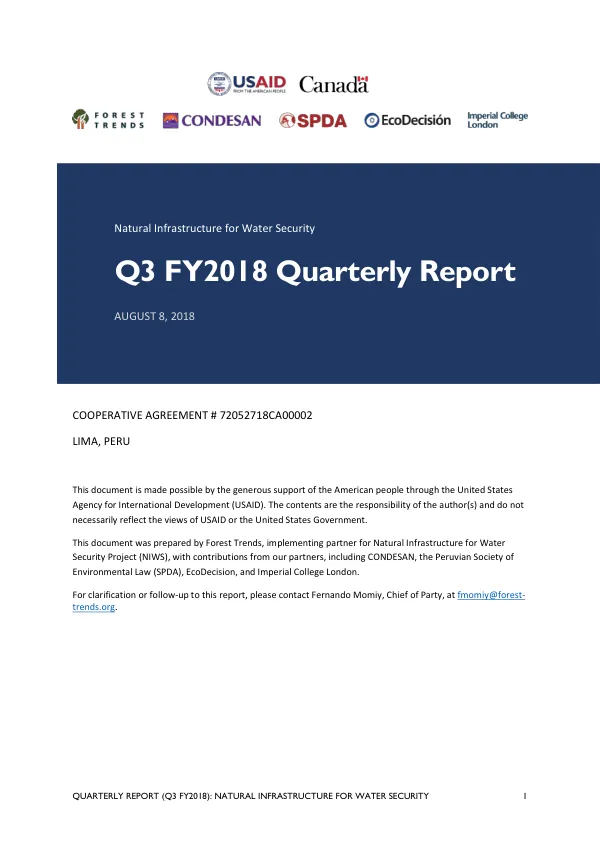
Quarterly Report (Q3 FY2018): Natural Infrastructure for Water Security
The Natural Infrastructure for Water Security Project (NIWS) is a collaborative effort between the Peruvian Government, the United States Agency for International Development (USAID), and other international partners.
2018 · 35 pages
Sign in to readA free account is required to download.
Abstract
The project aims to improve water security in Peru through the implementation of natural infrastructure solutions. In the second quarter of 2018, NIWS secured a renewed commitment from the Peruvian Government for natural infrastructure and continued to work with technical counterparts in key government agencies. Despite the change of government, NIWS was able to sustain coordination with technical counterparts and confirm continued commitment to working closely with the project. The project worked closely with partners on a range of targeted efforts, including workshops on hydrological monitoring and evaluation, watershed management, and multi-annual investment planning for natural infrastructure. The project also made significant progress in defining its areas of focus and collaboration in priority watersheds. Rapid assessments were conducted in Chira-Piura, Quilca-Chili, and Tambo-Moquegua to collect baseline information and inform the detailed NIWS strategy in each watershed. Learning sites were selected in four priority watersheds, and local organizations were engaged and evaluated for their relevant expertise and areas of local leadership. The project team also filled in with several new hires and settled into the project office in Miraflores. Forest Trends continued to follow up with the Peruvian Government to secure all requisite registrations and permissions to operate as a tax-exempt entity for NIWS activities in Peru. The project's public launch, held on June 13, 2018, demonstrated the continued commitment to working on natural infrastructure for water security under the new Peruvian Administration and the power of multi-lateral collaboration represented by the leadership of the US, Canadian, and Peruvian governments. The launch brought together high-level representatives from the Ministries of Environment, Housing, and Women, among others, as well as leaders from watershed councils, regional governments, civil society, the private sector, and international cooperation. The project's success story for this quarter highlights the impact of this event. The project's areas of focus and collaboration in each priority watershed are being defined, and rapid assessments are being conducted to collect baseline information. Learning sites have been selected, and local organizations are being engaged and evaluated for their relevant expertise and areas of local leadership. The project is making progress in its three main objectives: enabling environment for natural infrastructure improved, information management improved for decision-making on natural infrastructure, and natural infrastructure projects designed, financed, and implemented in vulnerable watersheds. The project is also implementing cross-cutting strategies and project administration, including monitoring, evaluation, and learning. The project's quarterly report provides an overview of its activities and results for the period of April 1, 2018, through June 30, 2018. The report includes an executive summary, acronyms, contents, introduction, activities and results, cross-cutting strategies and project administration, success story, monitoring, evaluation, and learning, and annexes.
Related documents