ABT ASSOCIATES
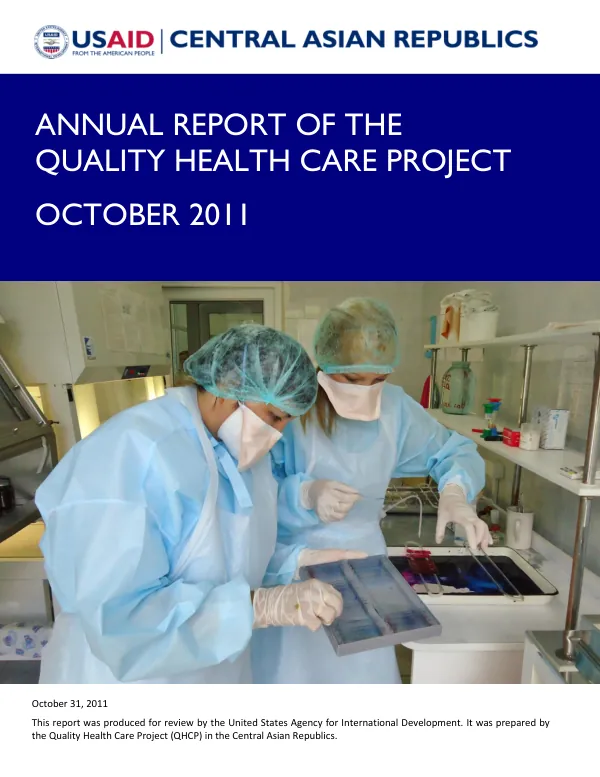
Annual Report of the Quality Health Care Project
The Quality Health Care Project in the Central Asian Republics was implemented by Abt Associates Inc.
2011 · 162 pages
Sign in to readA free account is required to download.
Abstract
and its subcontractors, with funding from the U.S. Agency for International Development under Contract No. AID-176-C-10-00001, beginning September 2010. The project aimed to improve health care services in Kazakhstan, Kyrgyzstan, and Tajikistan. In Kazakhstan, the project focused on tuberculosis (TB) and HIV/AIDS prevention, care, and treatment. TB prevalence was identified as a major public health concern, with 12 new cases reported per 100,000 population in 2011. The project implemented interventions to improve TB drug management, service delivery at primary health care and hospital levels, and laboratory capacity. Community action for health and TB/HIV collaboration were also prioritized. HIV/AIDS was another key area of focus in Kazakhstan. The project supported national-level prevention, care, and treatment programs, as well as social support services for people living with HIV/AIDS. Maternal and child health, family planning and reproductive health, and cardiovascular disease and non-communicable diseases (CVD/NCD) were also addressed through the project. In Kyrgyzstan, the project's objectives were similar to those in Kazakhstan. TB prevalence was reported at 14 new cases per 100,000 population in 2011. The project implemented interventions to improve TB drug management, service delivery, and laboratory capacity. HIV/AIDS prevention, care, and treatment programs were also supported, as well as social support services for people living with HIV/AIDS. Tajikistan was the third country where the project was implemented. TB prevalence was reported at 15 new cases per 100,000 population in 2011. The project focused on improving TB drug management, service delivery, and laboratory capacity, as well as HIV/AIDS prevention, care, and treatment programs. Maternal and child health, family planning and reproductive health, and CVD/NCD were also addressed through the project. The project's health financing and priority program cross-cutting activities were also implemented in all three countries. Institutionalization for sustainability and country-level monitoring and evaluation (M&E) systems were established to ensure the long-term impact of the project. The project's achievements in Kazakhstan, Kyrgyzstan, and Tajikistan were significant, with improvements in TB and HIV/AIDS services, as well as maternal and child health, family planning and reproductive health, and CVD/NCD. The project's success was attributed to the collaboration between the project team, government officials, and local stakeholders.
Related documents
Documents in this collection
 2012
2012USAID DEC
Central Asian Republics (2012): HIV and TB TRaC Study Understanding Risk Behaviors Associated with HIV Transmission and Utilization of HIV Prevention and HIV/TB Co-infection Prevention among People Who Inject Drugs
Open record 2011
2011USAID DEC