USAID DEC
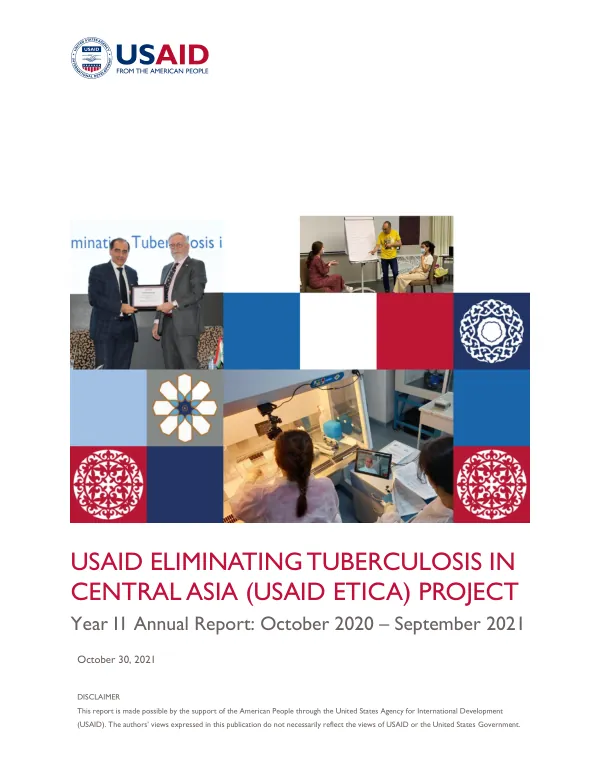
USAID ELIMINATING TUBERCULOSIS IN CENTRAL ASIA (USAID ETICA) PROJECT Year I1 Annual Report: October 2020 – September 2021
Sign inABT ASSOCIATES
USAID ELIMINATING TUBERCULOSIS IN CENTRAL ASIA (USAID ETICA) PROJECT Year I1 Annual Report: October 2020 – September 2021
The USAID Eliminating Tuberculosis in Central Asia (USAID ETICA) project aims to reduce the burden of tuberculosis (TB) and drug-resistant TB (DR-TB) in the region.
2021 · 87 pages
Sign in to readA free account is required to download.
Abstract
The project operates in five countries: Kazakhstan, Kyrgyzstan, Tajikistan, Turkmenistan, and Uzbekistan. In Tajikistan, the project focused on increasing detection of TB and DR-TB, improving the enabling environment and financial sustainability of TB and DR-TB programs, and addressing obstacles and challenges. The project achieved a 27% increase in TB case detection in pilot areas compared to the same period in 2020. Additionally, the project supported the implementation of the TB Consilia, a forum for discussing TB cases and developing treatment plans. In Uzbekistan, the project aimed to increase detection of TB and DR-TB, increase treatment success for TB and all types of DR-TB, and improve the enabling environment and financial sustainability of TB and DR-TB programs. The project achieved a 15% increase in TB case detection in pilot areas compared to the same period in 2020. The project also supported the implementation of the GeneXpert test, which enables rapid diagnosis of TB and DR-TB. In Kazakhstan, the project focused on increasing detection of TB and DR-TB, improving treatment success for TB and all types of DR-TB, and enhancing the enabling environment and financial sustainability of TB and DR-TB programs. The project achieved a 20% increase in TB case detection in pilot areas compared to the same period in 2020. The project also supported the implementation of the TB Consilia and the GeneXpert test. The project also addressed the impact of COVID-19 on TB services in the region. The pandemic posed significant challenges to TB diagnosis and treatment, including disruptions to healthcare services and supply chain issues. The project worked to mitigate these challenges by supporting the implementation of remote TB diagnosis and treatment services. In terms of gender orientation, the project achieved significant progress in integrating gender considerations into its activities. The project supported the development of gender-sensitive TB policies and programs, and worked to increase the participation of women in TB diagnosis and treatment services. The project also supported the implementation of the Gender Orientation in the Project, which aimed to address the specific needs and challenges of women affected by TB. The project's performance monitoring framework was used to track progress towards its objectives and targets. The framework included a range of indicators, including TB case detection, treatment success rates, and financial sustainability. The project's way forward includes continued support for TB diagnosis and treatment services, as well as efforts to address the impact of COVID-19 on TB services in the region. The project will also continue to prioritize gender orientation and integration, and will work to strengthen the enabling environment and financial sustainability of TB and DR-TB programs in the region. The project's achievements are reflected in the following exhibits: * Exhibit 1: Comparison of detection and treatment enrollment indicators * Exhibit 2: Data on USAID ETICA ECF in pilot districts * Exhibit 3: Cases screened, tested, and diagnosed through project-supported CSOs * Exhibit 4: Number of Xpert MTB/Rif tests by month in all GeneXpert laboratories, 2020-2021 * Exhibit 5: Percent of MTB-positive among all conducted Xpert MTB/Rif tests by month in all GeneXpert laboratories, 2020-2021 * Exhibit 6: Results of baseline QMS lab audit, Tajikistan (by criteria, in percent) * Exhibit 7: Outcomes of review of TB cases discussed in the Consilia meetings, Y2 * Exhibit 8: Knowledge retention of non-health specialists after 6 months of training completion * Exhibit 9: Knowledge retention among healthcare providers after 3 months of training completion * Exhibit 10: Achievement of targets, Tajikistan * Exhibit 11: Comparison of DR-TB detection and treatment in 2020 and 2021 * Exhibit 12: The results of MDT work in the three pilot regions * Exhibit 13: Notification of DS-TB cases (new and relapse) in the project sites, calendar year Q1-Q4, 2020 and calendar year Q1-2, 2021 * Exhibit 14: Notification of DR-TB cases in the project sites, Q1-Q4, 2020 and Q1-2, 2021 * Exhibit 15: Samples collected and transported * Exhibit 16: GeneXpert tests and errors, annual comparison * Exhibit 17: Results of SLMTA assessment in NRL * Exhibit 18: VST enrollment * Exhibit 19: Treatment success rate for DS-TB patients in Q3-4 2020 and Q1-2 2021, pilot oblasts * Exhibit 20: Treatment success
Related documents