MANAGEMENT SCIENCES FOR HEALTH
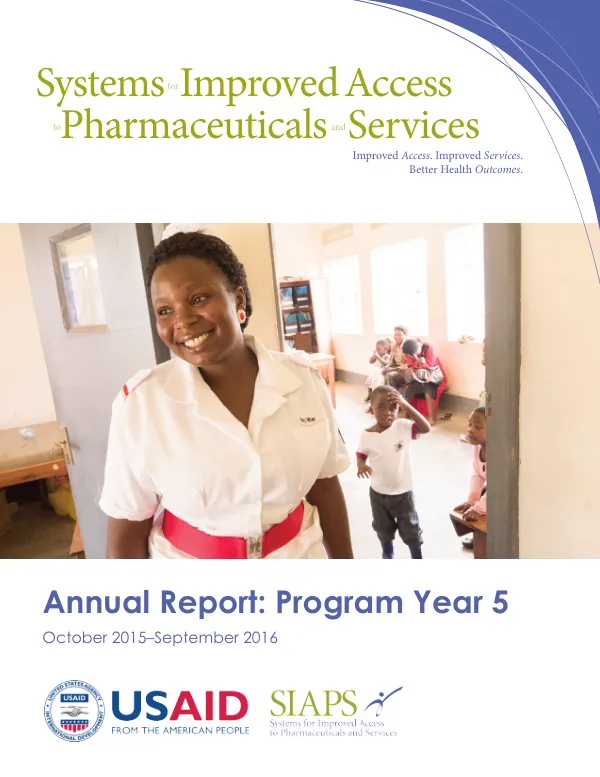
Annual Report: Program Year 5, October 2015–September 2016
Systems thinking is now a widely accepted concept in global health.
2016 · 156 pages
Sign in to readA free account is required to download.
Abstract
Governments, donors, and other actors in global health recognize that guaranteeing access to quality pharmaceutical products and services is essential for achieving desired health outcomes. The Systems for Improved Access to Pharmaceuticals and Services (SIAPS) Program aims to address this critical need by strengthening pharmaceutical systems in low- and middle-income countries. The SIAPS Program is a five-year initiative that began in 2011 and concluded in 2016. The program's goal is to improve access to quality pharmaceutical products and services, ultimately leading to better health outcomes. To achieve this goal, SIAPS focuses on five key result areas: improving governance, building capacity for pharmaceutical management and services, addressing information needed for decision-making in the pharmaceutical sector, strengthening financing strategies and mechanisms to improve access to medicines, and increasing quality pharmaceutical services. SIAPS works in partnership with national governments, international organizations, and local stakeholders to implement its programs. The program's approach is based on a systems thinking framework, which recognizes that pharmaceutical systems are complex and interconnected. By addressing the underlying systemic issues, SIAPS aims to create sustainable improvements in access to quality pharmaceutical products and services. In the past year, SIAPS has made significant progress in strengthening pharmaceutical systems in several countries. For example, in Angola, SIAPS worked with the Ministry of Health to establish a national pharmaceutical management information system, which has improved the tracking and monitoring of pharmaceutical supplies. In Bangladesh, SIAPS supported the development of a national essential medicine list, which has helped to ensure that essential medicines are available and accessible to patients. SIAPS has also made significant progress in building capacity for pharmaceutical management and services. In Benin, SIAPS trained over 200 healthcare workers in pharmaceutical management and services, which has improved the quality of care provided to patients. In Burundi, SIAPS supported the establishment of a national pharmaceutical training center, which has provided training to over 100 healthcare workers. In addition to its work in individual countries, SIAPS has also made significant progress in addressing information needed for decision-making in the pharmaceutical sector. In Cameroon, SIAPS supported the development of a national pharmaceutical information system, which has improved the tracking and monitoring of pharmaceutical supplies. In Central Asia, SIAPS worked with regional stakeholders to develop a regional pharmaceutical information system, which has improved the sharing of information and best practices across the region. Overall, SIAPS has made significant progress in strengthening pharmaceutical systems in low- and middle-income countries. By addressing the underlying systemic issues and building capacity for pharmaceutical management and services, SIAPS has improved access to quality pharmaceutical products and services, ultimately leading to better health outcomes.