USAID DEC
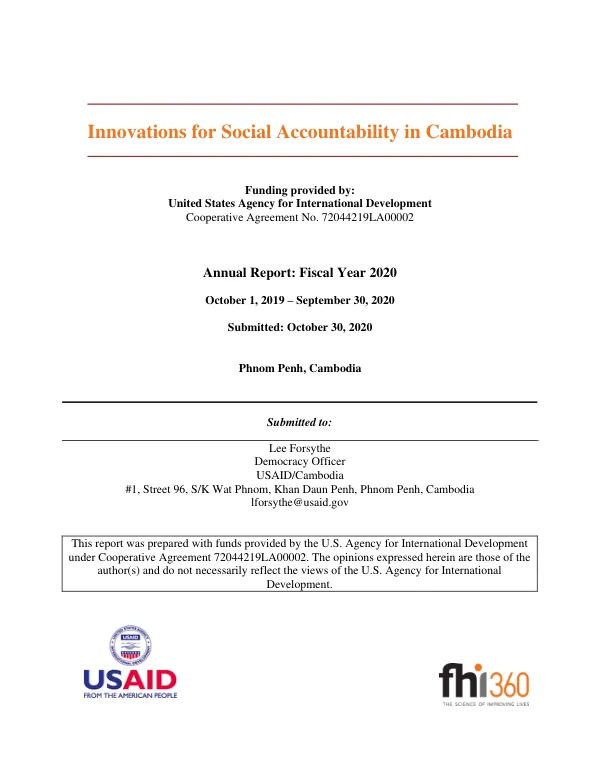
Annual Report: Year 1 (October 2019 – September 2020) Innovations for Social Accountability in Cambodia
Sign inDAI
Annual Report: Year 1 (October 2019 – September 2020) Innovations for Social Accountability in Cambodia
Innovations for Social Accountability in Cambodia is a five-year, $16 million project implemented by FHI 360 and its partners Internews, DAI, and Open Development Cambodia (ODC).
2020 · 44 pages
Sign in to readA free account is required to download.
Abstract
The project aims to support citizens in improving their capacity, access to information, and networks for collective action, enabling them to build public demand and develop solutions to address community priorities. The project's vision is that Cambodian citizens will have the information, knowledge, skills, and networks necessary to hold local government accountable after the project concludes. The project works with respected Cambodian civic organizations in urban areas to bring together diverse groups of citizens, civil society organizations (CSOs), technologists, and government officials to discuss shared community priorities and common issues, develop potential solutions, and undertake collective action to build demand for change. ISAC assists CSOs, civic leaders, and other groups and associations to enhance their networks for information sharing and collective action, making them better able to sustain the pressure for social accountability beyond the life of the project. In FY 2020, the project achieved several key outcomes. Outcome 1, Improved information access on government decisions and processes, and the planning, spending, and investment of public funds, was addressed through the Open Data Survey. The survey provided a profile of the available open data, data gaps, opportunities to use open data effectively, and challenges to filling gaps in social accountability data. The survey team carefully reviewed and profiled the supply and demand and overall media infrastructure for open data in Cambodia. Outcome 2, Increased citizen participation and collective action to hold local government accountable for public services, was achieved through the establishment of Community Accountability Facilitators (CAF) in urban areas. The CAFs worked with diverse groups of citizens, CSOs, technologists, and government officials to discuss shared community priorities and common issues, develop potential solutions, and undertake collective action to build demand for change. Outcome 3, Increased utilization of new or existing enabling technologies for citizens to hold local government accountable for delivery of public services, was addressed through the development of social accountability technology tools. The project increased the availability of credible, accessible, and easily-understood information and social accountability technology tools for use by CSOs, citizens, and journalists to strengthen civic understanding of government services and processes and improve accountability. Outcome 4, Education and outreach to raise awareness of accountability and integrity in public administration, was achieved through the development of educational materials and outreach activities. The project educated citizens, CSOs, and government officials about the importance of accountability and integrity in public administration, and provided them with the knowledge and skills necessary to promote these values. The project's achievements in FY 2020 demonstrate its commitment to supporting citizens in improving their capacity, access to information, and networks for collective action, and enabling them to build public demand and develop solutions to address community priorities. The project's vision of a Cambodia where citizens have the information, knowledge, skills, and networks necessary to hold local government accountable is being realized through its work in FY 2020.