THE ASIA FOUNDATION
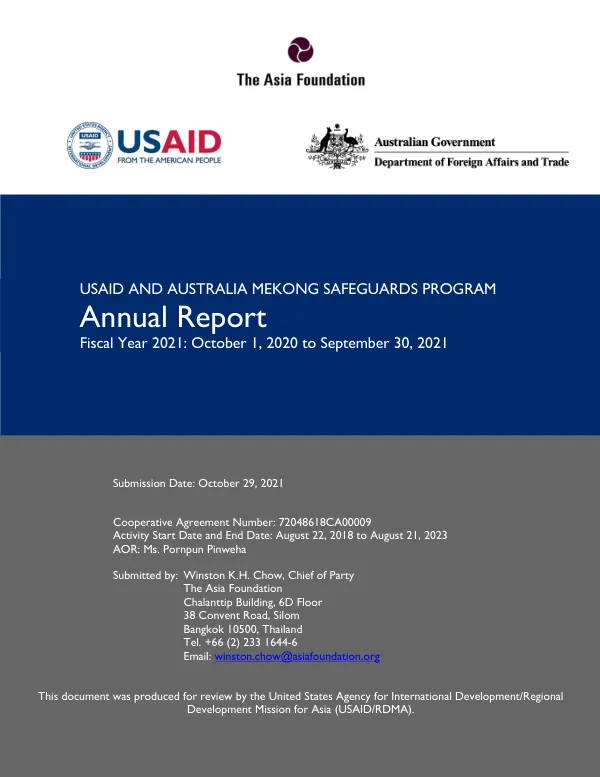
USAID and Australia Mekong Safeguards Program Annual Report – Fiscal Year 2021
The USAID and Australia Mekong Safeguards Program is a five-year program that supports improvements to environment and social safeguards standards and practices in infrastructure development projects in the Lower Mekong region.
2021 · 35 pages
Sign in to readA free account is required to download.
Abstract
The program aims to enhance the capacity of government regulators, major contractors, and other stakeholders to integrate environmental and social considerations into their decision-making processes. The program is implemented by The Asia Foundation, with sub-awardees including The Henry L. Stimson Center, Global Environmental Institute (GEI), China International Contractors Association (CHINCA), and Beijing Rongzhi Corporate Social Responsibility Institute (Rongzhi). The program's geographic coverage includes China and the Lower Mekong countries of Cambodia, Lao PDR, Myanmar, Thailand, and Vietnam. The program's objectives are to improve environment and social safeguards standards and practices in infrastructure development projects, and to enhance the capacity of government regulators, major contractors, and other stakeholders to integrate environmental and social considerations into their decision-making processes. The program's activities include research, training, and technical assistance, as well as the development of guidelines and tools to support the integration of environmental and social considerations into infrastructure development projects. The program's research activities focus on identifying best practices and lessons learned in integrating environmental and social considerations into infrastructure development projects. The program's training activities include workshops, training sessions, and capacity-building programs for government regulators, major contractors, and other stakeholders. The program's technical assistance activities include technical assistance to government regulators, major contractors, and other stakeholders to support the integration of environmental and social considerations into infrastructure development projects. The program's guidelines and tools include guidelines for environmental and social impact assessments, guidelines for environmental and social management systems, and tools for monitoring and evaluating environmental and social performance. The program's guidelines and tools are designed to support the integration of environmental and social considerations into infrastructure development projects and to enhance the capacity of government regulators, major contractors, and other stakeholders to make informed decisions about environmental and social issues. The program's monitoring and evaluation activities focus on tracking progress towards the program's objectives and outcomes. The program's monitoring and evaluation framework includes indicators for measuring progress towards the program's objectives and outcomes, as well as a system for tracking and reporting on progress. The program's budget for the fiscal year 2021 was $1.5 million, with $750,000 allocated for research and training activities, $500,000 allocated for technical assistance activities, and $250,000 allocated for guidelines and tools development. The program's budget for the fiscal year 2022 is $1.8 million, with $900,000 allocated for research and training activities, $600,000 allocated for technical assistance activities, and $300,000 allocated for guidelines and tools development. The program's staff includes a Chief of Party, a Program Manager, a Research and Training Coordinator, a Technical Assistance Coordinator, and a Monitoring and Evaluation Coordinator. The program's staff work closely with government regulators, major contractors, and other stakeholders to support the integration of environmental and social considerations into infrastructure development projects. The program's partnerships include partnerships with government agencies, international organizations, and civil society organizations. The program's partnerships are designed to support the integration of environmental and social considerations into infrastructure development projects and to enhance the capacity of government regulators, major contractors, and other stakeholders to make informed decisions about environmental and social issues. The program's achievements include the development of guidelines and tools for integrating environmental and social considerations into infrastructure development projects, the provision of training and technical assistance to government regulators, major contractors, and other stakeholders, and the conduct of research on best practices and lessons learned in integrating environmental and social considerations into infrastructure development projects.
Related documents