CARE
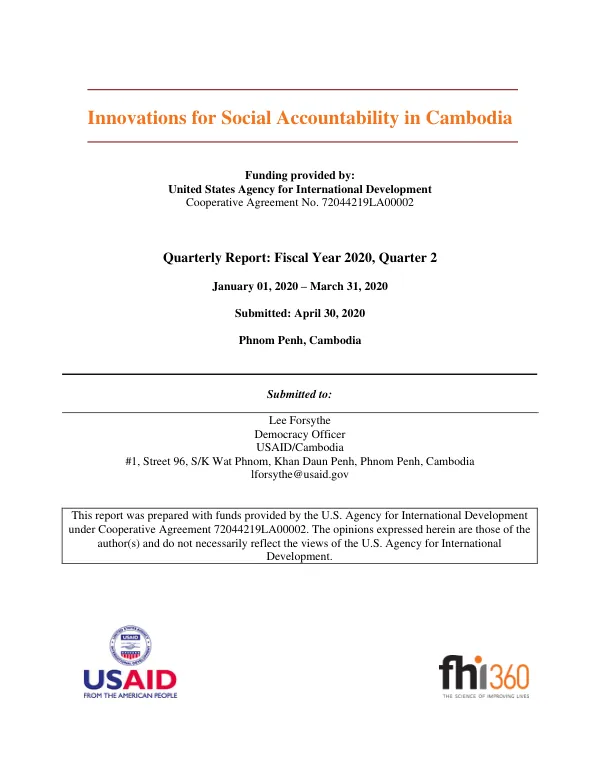
Quarterly Report: Fiscal Year 2020, Quarter 2
Innovations for Social Accountability in Cambodia is a five-year, $15 million USAID-funded program implemented by FHI 360 and its partners Internews, DAI, and Open Development Cambodia (ODC).
2020 · 27 pages
Sign in to readA free account is required to download.
Abstract
The program aims to support citizens in improving their access to information, networks for collective action, and skills necessary to hold local government accountable. The ISAC vision is that Cambodian citizens will have the necessary tools to hold local government accountable after the project concludes. The program will work with respected Cambodian civic organizations in urban areas to bring together citizens, civil society organizations (CSOs), technologists, and government officials to develop solutions to community priorities and undertake collective action. ISAC will assist CSOs and civic leaders to enhance their information sharing and collective action networks, making them better equipped to sustain the pressure for social accountability beyond the project's life. The program will also increase the availability of credible, accessible, and understandable information and social accountability technology tools for CSOs, citizens, and journalists. ISAC is working towards four outcomes: Improved information access on government decisions and processes, and the planning, spending, and investment of public funds; Increased citizen participation and collective action to hold local government accountable for public services; Increased utilization of existing enabling technologies for citizens to hold local government accountable for delivery of public services; and Education and outreach to raise awareness of accountability and integrity in public administration. In Q2, FHI 360 onboarded several staff members, including Social Accountability Specialist Ratha Sear, Monitoring and Evaluation Specialist Men Chebona, and six Field Coordinators for various provinces. DAI hired two full-time staff members, including DCOP/Senior Technology Program Manager Krisna Keo and Operations Specialist Saren Cheang. Internews also completed its recruitment, appointing experienced journalist May Titthara as Media Specialist and Sothara Phon as Finance and Administration officer. FHI 360 continued its efforts to finalize a Memorandum of Understanding (MOU) with the National Committee of Sub-National Democratic Development (NCDD) under the Ministry of Interior (MOI). Revised versions of the MOU were submitted to the NCDD in both Khmer and English for signature, but the signing of the MOU was pending a request from NCDD that ISAC provide additional information. The program has made significant progress in Q2, with the onboarding of new staff members and the completion of recruitment by partner organizations. The MOU with the NCDD is still pending, but ISAC is working to finalize the agreement. The program's outcomes are expected to improve information access, increase citizen participation, increase utilization of enabling technologies, and raise awareness of accountability and integrity in public administration. In Q2, the program implemented several activities to support its outcomes. The Field Coordinators were onboarded and began working in their respective provinces. FHI 360 also conducted a presentation on ISAC to the NCDD Monitoring, Evaluation, and Information Division. The program's partners, including Internews and DAI, completed their recruitment and began implementing their activities. The program's progress is expected to continue in Q3, with the signing of the MOU with the NCDD and the implementation of several activities to support the program's outcomes. The program's outcomes are expected to improve information access, increase citizen participation, increase utilization of enabling technologies, and raise awareness of accountability and integrity in public administration. The program's budget for Q2 was $1.5 million, which was allocated to support the onboarding of new staff members, the completion of recruitment by partner organizations, and the implementation of several activities to support the program's outcomes. The program's budget for Q3 is expected to be $1.8 million, which will be allocated to support the signing of the MOU with the NCDD and the implementation of several activities to support the program's outcomes. The program's monitoring and evaluation plan includes several indicators to measure progress towards the program's outcomes. The indicators include the number of citizens who have access to information on government decisions and processes, the number of citizens who participate in collective action to hold local government accountable, and the number of citizens who use enabling technologies to hold local government accountable. The program's monitoring and evaluation plan also includes several activities to track progress towards the program's outcomes, including surveys, focus groups, and focus group discussions. The program's implementation challenges include the signing of the MOU with the NCDD, which is still pending. The program also faces challenges in implementing its activities, including the availability of resources and the capacity of the program's staff. The program's partners, including Internews and DAI, also face challenges in implementing their activities, including the availability of resources and the capacity of their staff. The program's planned activities for Q3 include the signing of the MOU with the NCDD, the implementation of several activities to support the program's outcomes, and the tracking of progress towards the program's outcomes. The program's budget for Q3 is expected to be $1.8 million, which will be allocated to support the signing of