USAID DEC
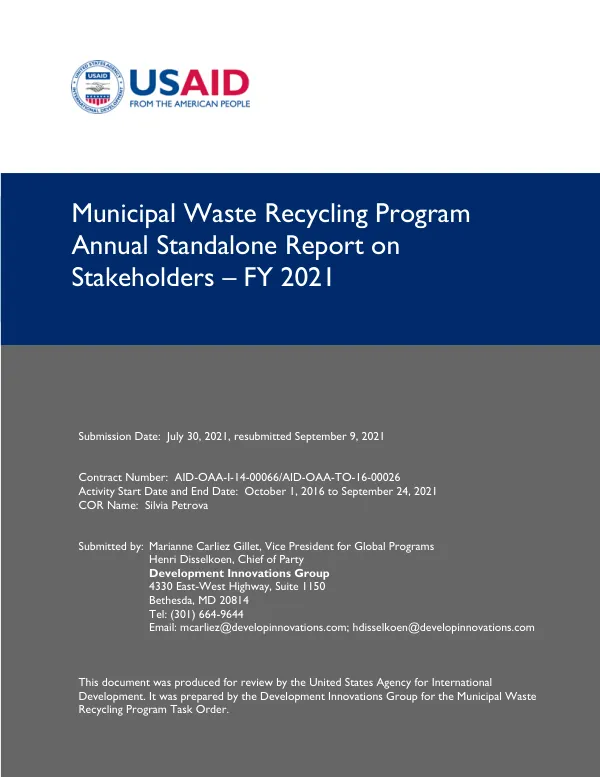
Annual Standalone Report on Stakeholders for the Municipal Waste Recycling Program (MWRP)
Sign inCATHOLIC RELIEF SERVICES ORGANIZATION
Annual Standalone Report on Stakeholders for the Municipal Waste Recycling Program (MWRP)
The Municipal Waste Recycling Program (MWRP) is a five-year, USAID-funded initiative that aimed to improve municipal waste recycling efforts in Asia.
2021 · 23 pages
Sign in to readA free account is required to download.
Abstract
The program focused on identifying and scaling innovations that improve municipal waste recycling in four Asian countries: the Philippines, Sri Lanka, Vietnam, and Indonesia. These countries are among the world's top producers of plastic waste, and improving their municipal waste management systems is crucial to reducing plastic pollution in the oceans. MWRP provided grants and technical assistance to support promising municipal waste recycling efforts in the target countries. The program worked closely with USAID and fostered engagement with various stakeholders, including local and national governments, the private sector, and civil society organizations operating in the solid waste management sector. Despite COVID-19 restrictions, MWRP grantees organized and participated in various events with stakeholders to strengthen municipal solid waste management systems. One of the key strategies employed by MWRP was to promote collaboration among stakeholders to improve the efficiency of municipal solid waste management systems. MWRP grantees helped strengthen the relationships between local/national government entities and private sector entities, including large businesses, plastic waste value chain operators, and civil society organizations. The program supported the formalization of the status of informal, private sector solid waste management actors, such as independent waste collectors, and promoted multi-stakeholder dialogues and forums. In Indonesia, the Misool Foundation expanded its Sorong City regional network for collecting recyclable materials, reaching a total of 115 community waste bank and independent waste collector collection points. In Sri Lanka, the Ceylon Chamber of Commerce played a critical role in organizing multi-stakeholder dialogues that led to the design of an Extended Producer Responsibility (EPR) roadmap, which was endorsed by the government and private sectors. In Semarang City, Indonesia, the Bintari Foundation facilitated consultations with the city environment department to formulate new waste management and recycling policies. MWRP also fostered public-private stakeholder cooperation by co-sponsoring public events and sharing information on solid waste management issues and solutions. The program's efforts led to increased economic opportunities for independent waste collectors and helped strengthen local solid waste management and recycling systems. The partnerships forged under MWRP will continue to benefit the target communities beyond the end of the program. The MWRP team continued to promote collaboration among stakeholders to improve municipal solid waste management systems in FY2021. MWRP grantees helped strengthen the relationships between local/national government entities and private sector entities, including large businesses, plastic waste value chain operators, and civil society organizations. The program supported the formalization of the status of informal, private sector solid waste management actors, such as independent waste collectors, and promoted multi-stakeholder dialogues and forums. MWRP's engagement with stakeholders involved in ocean plastic pollution reduction efforts resulted in several achievements, including the expansion of community waste banks and independent waste collector networks, the design of an Extended Producer Responsibility (EPR) roadmap, and the formulation of new waste management and recycling policies. The program's efforts led to increased economic opportunities for independent waste collectors and helped strengthen local solid waste management and recycling systems. The next steps for MWRP include continuing to foster public-private stakeholder cooperation and promoting collaboration among stakeholders to improve municipal solid waste management systems. The program will also continue to support the formalization of the status of informal, private sector solid waste management actors and promote multi-stakeholder dialogues and forums. The partnerships forged under MWRP will continue to benefit the target communities beyond the end of the program.