DAI GLOBAL, LLC
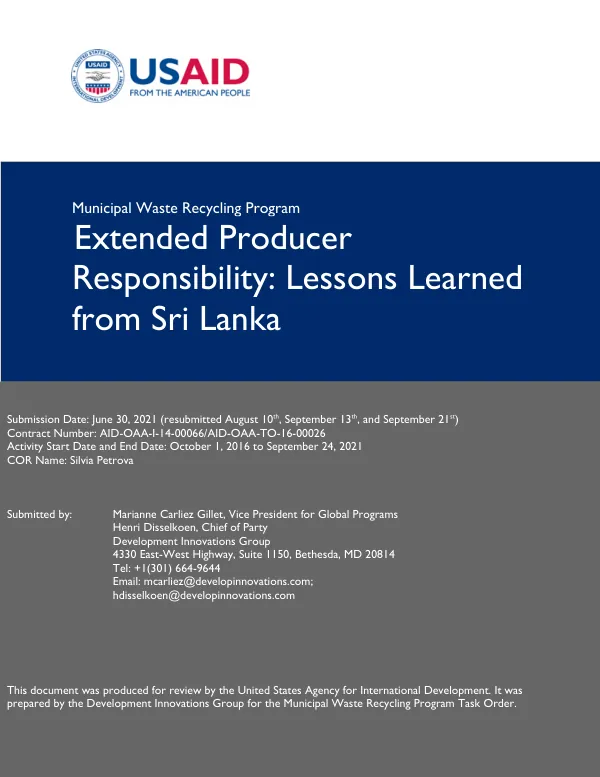
Final Extender Producer Responsibility Report
The Municipal Waste Recycling Program (MWRP) is a five-year waste management program funded by the United States Agency for International Development (USAID) to reduce land-based sources of ocean plastic pollution in four Asian countries: Indonesia, the Philippines, Sri Lanka, and Vietnam.
2021 · 20 pages
Sign in to readA free account is required to download.
Abstract
The program aims to introduce innovative, scalable solid waste management (SWM) approaches and increase municipal waste recycling investment in coastal cities. In Sri Lanka, the Ceylon Chamber of Commerce (CCC), a grantee under MWRP, played a key role in bringing together the national government, civil society, and large private sector plastic producers, collectors/recyclers, and consumers to agree on an extended producer responsibility (EPR) mechanism. The EPR mechanism places technical and financial responsibility on producers and brand owners for the environmentally conscious treatment and disposal of post-consumer plastic packaging. Sri Lanka generates 7,500 metric tons of solid waste per day, including 400 metric tons of plastic waste. Currently, between 5% and 20% of that plastic waste is recycled. The National Environmental Act No. 47 of 1980 provides overall provisions for the protection and management of Sri Lanka's environment, but there is no comprehensive policy framework directly addressing the management of plastic waste. The Sri Lankan government views an EPR policy approach as a feasible solution to addressing the island's plastic waste management issues. However, previous efforts to regulate plastic through partial bans or an EPR mechanism failed due to a lack of data and private sector involvement. A functioning EPR mechanism relies on accurate data on plastic production and use, including data on plastic value chains, which is currently unavailable. To address these challenges, the CCC intervened on behalf of the industry clusters and assured the Ministry of Environment that an EPR mechanism could be implemented in a practical and feasible manner. The CCC worked with the government, civil society, and private sector stakeholders to design a multi-stakeholder approach to EPR, which included the development of a comprehensive policy framework and the establishment of a Producer Responsibility Organization (PRO). The finalized EPR Roadmap for Plastic Waste Management in Sri Lanka, developed under MWRP, was submitted to USAID in February 2021. The report details the history of setting up an EPR mechanism in Sri Lanka, including the cooperation among plastic manufacturers, civil society organizations, and the government, as well as the challenges and solutions in designing a multi-stakeholder approach. The report also includes a summary of recommendations to help decision-makers beyond Sri Lanka develop an EPR that secures private sector support. The recommendations include the need for accurate data on plastic production and use, the establishment of a PRO, and the development of a comprehensive policy framework that addresses the management of all types of single-use plastics. The implementation of the EPR Roadmap is ongoing, with the CCC working closely with the government, civil society, and private sector stakeholders to ensure its successful implementation. The report provides a valuable case study for other countries seeking to develop an EPR mechanism to address their plastic waste management issues.