USAID DEC
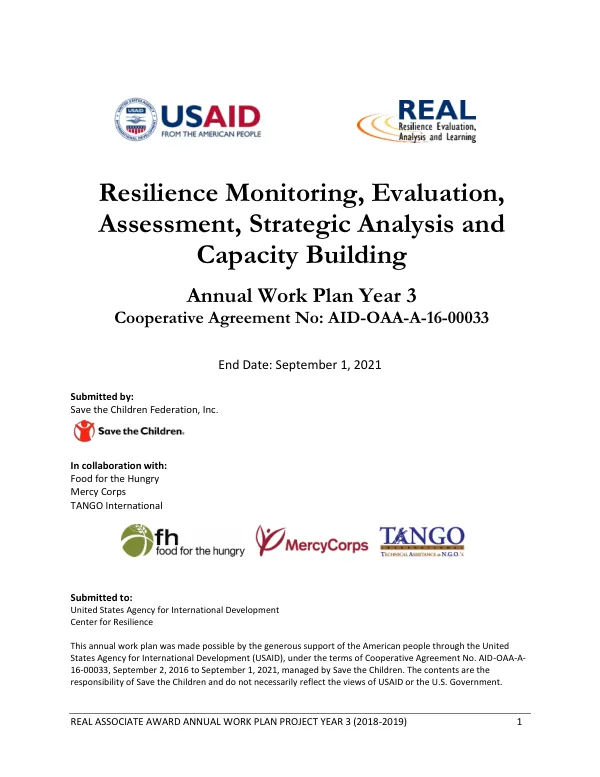
Annual Work Plan for the Resilience Evaluation, Analysis, and Learning (REAL) Associate Award
Sign inFOOD FOR THE HUNGRY, INTERNATIONAL
Annual Work Plan for the Resilience Evaluation, Analysis, and Learning (REAL) Associate Award
The REAL Associate Award is a five-year project issued under The TOPS Program Leader with Associates Cooperative Agreement, which aims to enhance opportunities for sharing knowledge and promising practices among practitioners in the multifaceted food security community.
2018 · 28 pages
Sign in to readA free account is required to download.
Abstract
The project is led by Save the Children, in collaboration with Food for the Hungry, Mercy Corps, and TANGO International, and is supported by the USAID Center for Resilience (C4R). The REAL Associate Award aims to identify, synthesize, adapt, and share the highest quality information and tools to build capacity and establish best practices among USAID Missions, implementing partners, and host country governments working together in resilience programming. The project focuses on developing practical guidance, carrying out assessments and evaluations, and providing strategic analyses, training, and other field support to address the needs of various stakeholders in the resilience programming community of practice. The project is guided by a Strategic Objective (SO) to identify, generate, adapt, and share highest quality information, knowledge, and best practices for improved methodologies in resilience program design, measurement, implementation, monitoring, and evaluation. The project is organized into four Project Results, each with Intermediate Results (IPRs) that are described in the Annual Work Plan. Project Result 1: Knowledge Capture involves consolidating and synthesizing existing data and information to inform programmatic, strategic, and policy-level decision making. The project will identify the knowledge and skill needs of the community by engaging members through participatory processes and soliciting their direct input. This process will provide an opportunity to identify promising tools and practices in current use, as well as gaps that must be filled to ensure quality resilience analysis and programming. Project Result 2: Knowledge Generation involves synthesizing and responding to information gained through the knowledge capture strategies to produce reliable, high-quality information in formats that are useful to USAID Missions, the implementing partner community, and other key stakeholders. The project will identify, adapt, and develop promising tools and practices in close collaboration with the USAID Center for Resilience (C4R). Information, tools, and approaches developed through the REAL Award will be shared through technical meetings, open and inclusive knowledge sharing meetings, the Food Security and Nutrition (FSN) Network REAL website, and other means. Project Result 3: Knowledge Application involves using effective and appropriate capacity building approaches to build the capacity of USAID Missions, implementing partners, and host country governments to design, implement, and evaluate resilience programs. The project will provide training, technical assistance, and other field support to address the needs of various stakeholders in the resilience programming community of practice. Project Result 4: Knowledge Sharing involves supporting and expanding information, skills, and knowledge exchange among USAID Missions, implementing partners, and host country governments. The project will facilitate technical meetings, open and inclusive knowledge sharing meetings, and other means to share information, tools, and approaches developed through the REAL Award. The REAL Associate Award Management processes, including challenges and lessons learned in Years 1-2, are described in the Annual Work Plan. The project will continue to focus on developing practical guidance, carrying out assessments and evaluations, and providing strategic analyses, training, and other field support to address the needs of various stakeholders in the resilience programming community of practice.