FOOD FOR THE HUNGRY, INTERNATIONAL
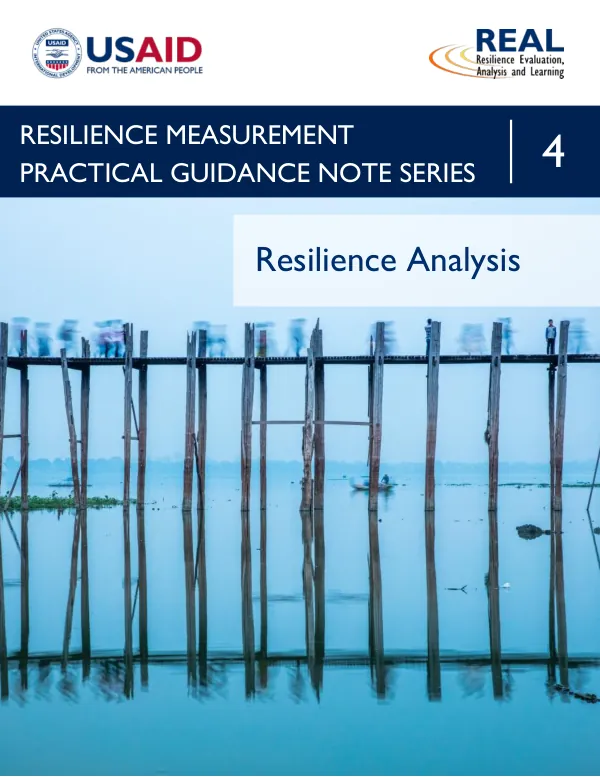
Resilience Measurement Practical Guidance Note Series 4: Resilience Analysis
Resilience has emerged as a key concept in understanding and addressing the increasing complexity and magnitude of risk in humanitarian and development contexts.
2018 · 28 pages
Sign in to readA free account is required to download.
Abstract
The USAID Resilience Measurement Practical Guidance Note Series aims to provide new insights based on recent efforts to assess, analyze, monitor, and evaluate resilience. This guidance note, the fourth in the series, focuses on approaches for conducting resilience analysis. The USAID defines resilience as "the ability of people, households, communities, countries, and systems to mitigate, adapt to, and recover from shocks and stresses in a manner that reduces chronic vulnerability and facilitates inclusive growth." This definition describes the relationship between three elements that form the basis of a resilience measurement framework – resilience capacities, shocks and stresses, and well-being outcomes. The resilience measurement framework is composed of three components: resilience capacities, which refer to the ability of individuals, households, or communities to withstand and recover from shocks and stresses; shocks and stresses, which are events or conditions that can affect well-being outcomes; and well-being outcomes, which are the results of resilience capacities and shocks and stresses. The guidance note describes various quantitative and qualitative approaches to analyzing these three components of the resilience measurement framework. It provides an overview of many of the quantitative and qualitative approaches used for resilience analysis, identifies examples and resources for further exploration and capacity development, and aims to equip readers with a basic understanding of what is entailed in each of the analytical approaches. The guidance note emphasizes the importance of defining research purpose and objectives in conducting a resilience analysis. There are two broad purposes for resilience analysis: gaining an understanding of resilience dynamics in a specific context and setting strategies for investment or programming that effectively enhance resilience. Having a clear understanding of the research purpose and objectives is integral to formulating clear and researchable questions. The guidance note outlines four steps for conducting a resilience analysis: defining research purpose, defining research questions, exploring range of methodological/analytical options, and selecting appropriate method(s) based on ability to respond to questions effectively and rigorously, data requirements, financial, time, and personnel constraints, etc. The guidance note addresses the first two steps in this process and explores the range of methodological and analytical options in sections three and four. The resilience analysis process involves specifying estimation models, selecting indicators and indices, and conducting quantitative and qualitative analyses. The guidance note provides an overview of various quantitative and qualitative approaches to analyzing resilience capacities, shocks and stresses, and well-being outcomes. It highlights the main assumptions, strengths, and weaknesses of the different analytical approaches and provides examples and resources for further exploration and capacity development. Overall, the guidance note provides practical guidance for conducting resilience analysis and aims to equip readers with a basic understanding of what is entailed in each of the analytical approaches. It emphasizes the importance of defining research purpose and objectives and outlines the steps for conducting a resilience analysis. The guidance note is intended to provide new insights based on recent efforts to assess, analyze, monitor, and evaluate resilience and to support the development of strategies and programs that increase resilience.
Related documents