DELOITTE CONSULTING, LLP
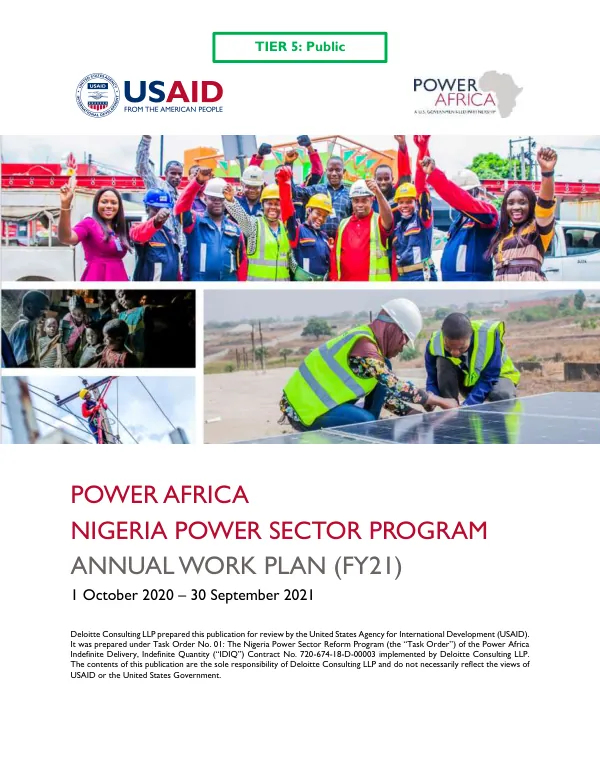
Annual Work Plan (FY21) for the Nigeria Power Sector Program
The Nigeria Power Sector Program, a component of the Power Africa initiative, aims to increase access to electricity in Nigeria.
2021 · 85 pages
Sign in to readA free account is required to download.
Abstract
The program is implemented by Deloitte Consulting LLP under a contract with the United States Agency for International Development (USAID). The program's primary objective is to increase private sector investment in the power sector, facilitate connections, improve the enabling environment, and promote improved liquidity. The program is structured around four key outcomes: increasing private sector investment in energy resources, facilitating connections, improving the enabling environment, and promoting improved liquidity. Outcome 1 focuses on increasing private sector investment in energy resources, specifically gas supply and on-grid generation. Technical context, challenges, and assumptions for this outcome include the need to increase gas supply to power plants, address infrastructure gaps, and improve regulatory frameworks. Interventions for Outcome 1 include supporting the development of gas supply infrastructure, facilitating the negotiation of gas supply agreements, and providing technical assistance to power plants. The program also aims to increase private sector investment in on-grid generation through interventions such as supporting the development of independent power projects, providing technical assistance to power plants, and facilitating the negotiation of power purchase agreements. Outcome 2 focuses on facilitating connections, specifically off-grid connections. Technical context, challenges, and assumptions for this outcome include the need to increase access to electricity in rural areas, address infrastructure gaps, and improve regulatory frameworks. Interventions for Outcome 2 include supporting the development of off-grid energy infrastructure, facilitating the negotiation of off-grid energy supply agreements, and providing technical assistance to off-grid energy providers. Outcome 3 focuses on improving the enabling environment, specifically through regulatory reforms. Technical context, challenges, and assumptions for this outcome include the need to improve regulatory frameworks, address infrastructure gaps, and increase transparency and accountability. Interventions for Outcome 3 include supporting regulatory reforms, providing technical assistance to regulatory agencies, and facilitating the negotiation of agreements between regulatory agencies and private sector stakeholders. Outcome 4 focuses on promoting improved liquidity, specifically through the distribution of electricity. Technical context, challenges, and assumptions for this outcome include the need to improve the efficiency of electricity distribution, address infrastructure gaps, and increase transparency and accountability. Interventions for Outcome 4 include supporting the development of electricity distribution infrastructure, facilitating the negotiation of electricity supply agreements, and providing technical assistance to electricity distribution companies. The program also includes a project management component, which focuses on partnerships, alliances, and coordination, communications and outreach, gender and social inclusion, environmental compliance and social impact, results management, monitoring, evaluation, and learning, and knowledge management. The program's finance and operations component includes operations, project staffing, subcontractors, and finance management. The program's performance indicator targets for FY21 include increasing private sector investment in energy resources, facilitating connections, improving the enabling environment, and promoting improved liquidity. The program's deliverables for FY21 include supporting the development of gas supply infrastructure, facilitating the negotiation of gas supply agreements, and providing technical assistance to power plants, as well as supporting the development of off-grid energy infrastructure, facilitating the negotiation of off-grid energy supply agreements, and providing technical assistance to off-grid energy providers. The program's activity charts for FY21 include a detailed breakdown of the program's activities and deliverables for each outcome. The program's organigram for FY20Q3 includes a detailed breakdown of the program's organizational structure and staffing.