USAID DEC
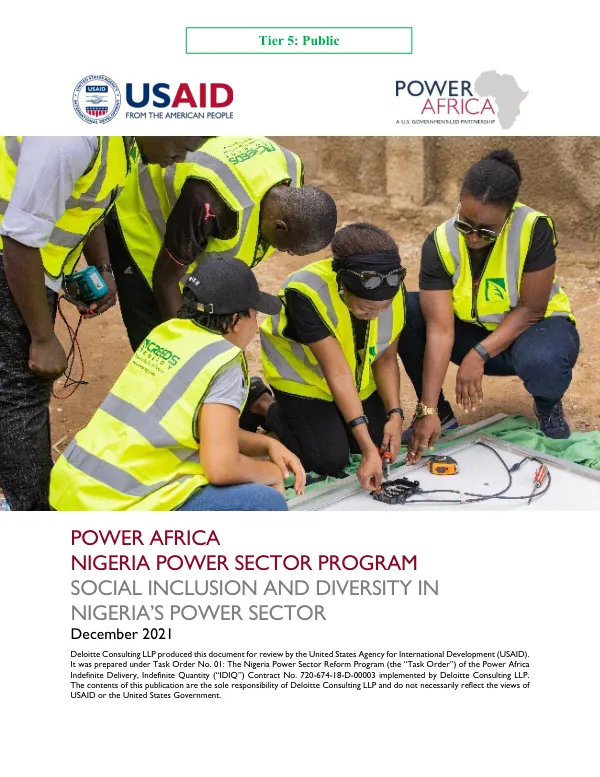
Social Inclusion and Diversity in Nigeria’s Power Sector: Legal, Policy, and Regulatory Framework
Sign inDELOITTE CONSULTING, LLP
Social Inclusion and Diversity in Nigeria’s Power Sector: Legal, Policy, and Regulatory Framework
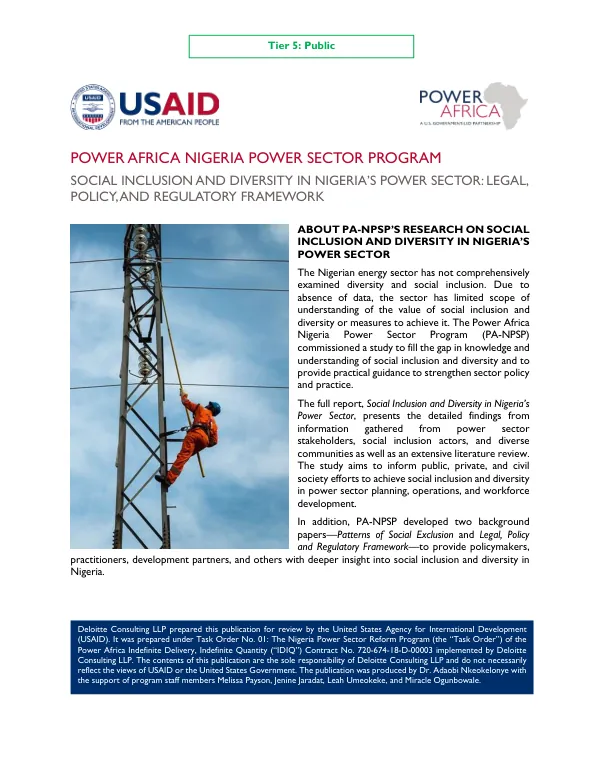
The Nigerian energy sector has not comprehensively examined diversity and social inclusion.
2021 · 10 pages
Sign in to readA free account is required to download.
Abstract
The absence of data has limited the sector's understanding of the value of social inclusion and diversity or measures to achieve it. The Power Africa Nigeria Power Sector Program (PA-NPSP) commissioned a study to fill the knowledge gap and provide practical guidance to strengthen sector policy and practice. Nigeria has ratified several international conventions and protocols that address social inclusion and diversity. The International Convention on the Elimination of All Forms of Racial Discrimination, ratified in 1993, addresses all forms of racial or ethnic discrimination. The United Nations Convention on the Rights of Persons with Disabilities, ratified in 2007, and its Optional Protocol, ratified in 2010, promote equal treatment and prohibit employee discrimination. Nigeria has also ratified the Equal Remuneration Convention 1951 (No. 100) and the Discrimination (Employment and Occupation) Convention 1958 (No. 111). The Convention on Elimination of all Forms of Discrimination against Women (CEDAW) defines what constitutes discrimination against women and includes an agenda for national action to empower women. Nigeria became a signatory to CEDAW in 1985 and ratified the convention in 1989 and the optional protocol in 1999. However, Nigeria has not adopted any national laws or protocols to implement the convention. Nigeria has also endorsed the United Nations' Sustainable Development Goals (SDG), including SDG 7, which focuses on expanding infrastructure and upgrading technology to provide affordable energy for all. The African Union Agenda 2063 aligns with SDG 7 and prioritizes providing social security and protection, especially for persons with disabilities. Nigeria ratified the African Charter on Human Rights in 1983, which protects the rights of all individuals, without distinction of race, ethnic group, color, sex, language, religion, political or any other opinion, national and social origin, fortune, birth, or other status. The African Union has established several protocols and charters that address social inclusion and diversity. The Protocol to the African Charter on Human and Peoples' Rights on the Rights of Older Persons protects older women against abuse and discrimination based on gender. The Protocol to the African Charter on Human and Peoples' Rights on the Rights of Women in Africa seeks to mainstream gender in laws, policy decisions, development plans and activities, and all spheres of life. The Protocol to the African Charter on Human and Peoples' Rights on the Rights of Persons with Disabilities in Africa promotes and protects the rights of persons with disabilities, ensuring their inherent dignity. Nigeria is a member of the African Network of Centers of Excellence in Electricity (ANCEE), which aims to improve power sector performance in Africa and power companies' technical and managerial capacities. ANCEE promotes gender equality in the workplace by increasing women's representation in technical and decision-making positions. Nigeria has committed to reserving 33 percent of training courses for women and 50 percent for employees from vulnerable contexts. Nigeria is bound by the regional Economic Community of West African States (ECOWAS) and abides by its Policy for Gender Mainstreaming in Energy Access, which has a gender-equality goal. The ECOWAS Program on Gender Mainstreaming in Energy Access (ECOWGEN) aims to understand the energy needs of men and women and rectify the differentiated ways energy access affects men and women. The ECOWAS Directive on Gender Assessments in Energy Projects is the standard for human rights in West Africa's power sector, ensuring that women, men, and vulnerable and marginalized people are not excluded from the energy infrastructure. Nigeria's National Laws, Policies, and Plans address social inclusion and diversity. The Constitution of the Federal Republic of Nigeria 1999 (CFRN, 1999) empowers citizens to seek enforcement in a court of law and provides facilities that encourage mobility of people and services, including electricity services for all Nigerians. The concept of federalism in Nigeria requires the President and agencies of government to consider the federal character of Nigeria and the need to promote national unity in making appointments. The Federal Character Commission is charged with addressing marginalization by adopting equitable measures for the distribution of socioeconomic services, amenities, infrastructure, and other benefits.
Related documents