DELOITTE CONSULTING, LLP
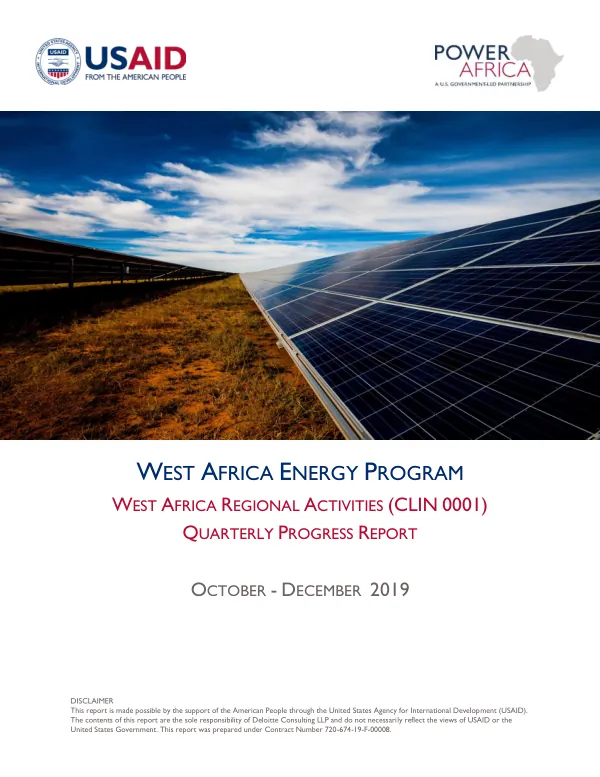
Quarterly Progress Report: West Africa Energy Program (WAEP)
The West Africa Energy Program (WAEP) is a USAID-funded initiative aimed at improving energy access and security in the region.
2020 · 35 pages
Sign in to readA free account is required to download.
Abstract
The program's primary objective is to optimize the supply of power in West Africa, enable expanded end-user access to grid-based power, improve technical and institutional capacity of select national utilities, and accelerate the establishment of a high-functioning regional power market. During the reporting period from October 1, 2019, to December 31, 2019, the WAEP team finalized its mobilization period and transitioned into the project implementation phase. Stakeholder engagement activities were conducted to facilitate collaboration and coordination among key stakeholders, including government officials, utility companies, and civil society organizations. Country and regional highlights indicate that significant progress was made in several areas. In Ghana, the WAEP team worked with the Electricity Company of Ghana to develop a comprehensive energy sector reform plan. In Nigeria, the team supported the Nigerian Electricity Regulatory Commission in developing a new regulatory framework for the power sector. In Senegal, the WAEP team collaborated with the Senegalese government to develop a national energy policy. Activities and results show that the WAEP team made significant progress in achieving its objectives. The team conducted a comprehensive assessment of the energy sector in West Africa, which identified key challenges and opportunities for improvement. The assessment highlighted the need for increased investment in the energy sector, improved regulatory frameworks, and enhanced capacity building for utility companies. The WAEP team also engaged in several stakeholder engagement activities, including workshops, meetings, and training sessions. These activities aimed to build capacity, foster collaboration, and promote knowledge sharing among key stakeholders. The team worked closely with government officials, utility companies, and civil society organizations to develop and implement strategies for improving energy access and security in the region. Outcome 1 - Optimize the supply of power in West Africa - The WAEP team made significant progress in this area, conducting a comprehensive assessment of the energy sector and identifying key challenges and opportunities for improvement. The team also worked with government officials and utility companies to develop and implement strategies for improving energy supply. Outcome 2 - Enable expanded end-user access to grid-based power that is reliable and affordable - The WAEP team made progress in this area, working with utility companies to develop and implement strategies for improving energy access. The team also conducted training sessions and workshops to build capacity and promote knowledge sharing among key stakeholders. Outcome 3 - Improve technical and institutional capacity and performance of select national utilities - The WAEP team made significant progress in this area, working with utility companies to develop and implement strategies for improving technical and institutional capacity. The team also conducted training sessions and workshops to build capacity and promote knowledge sharing among key stakeholders. Outcome 4 - Accelerate the establishment of a high-functioning regional power market - The WAEP team made progress in this area, working with government officials and utility companies to develop and implement strategies for improving regional energy trade. The team also conducted training sessions and workshops to build capacity and promote knowledge sharing among key stakeholders. Support functions and cross-cutting activities highlights indicate that the WAEP team made significant progress in several areas, including support to the Power Africa Coordinator's Office and USAID missions, collaboration with other USAID projects, communications and outreach, environmental status report, monitoring, evaluation, and learning, and gender strategy and integration.
Related documents