USAID DEC
Antecedents and outcomes of supply chain security practices: the role of organizational security culture and supply chain disruption occurrence
Sign inUSAID DEC
Antecedents and outcomes of supply chain security practices: the role of organizational security culture and supply chain disruption occurrence
Organizational security culture plays a crucial role in driving supply chain security practices.
2021 · 2 pages
Sign in to readA free account is required to download.
Abstract
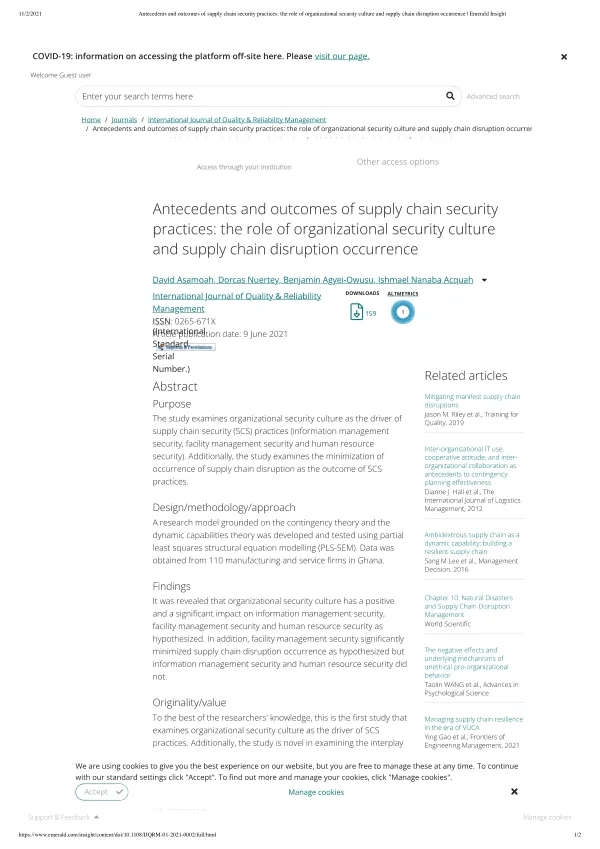
Research has identified three key components of supply chain security: information management security, facility management security, and human resource security. Organizational security culture has a positive impact on these components, with a significant effect on facility management security. A study conducted in Ghana involved 110 manufacturing and service firms. The research model, grounded in contingency theory and dynamic capabilities theory, was tested using partial least squares structural equation modeling (PLS-SEM). The findings revealed that organizational security culture has a significant impact on information management security, facility management security, and human resource security. However, only facility management security was found to significantly minimize supply chain disruption occurrence. Organizational security culture is a critical driver of supply chain security practices, and its impact on facility management security is particularly noteworthy. Facility management security involves measures to protect physical assets, such as warehouses and transportation systems, from theft, damage, or other forms of disruption. Effective facility management security can help minimize the occurrence of supply chain disruptions, which can have significant consequences for businesses and their customers. The study's findings have important implications for organizations seeking to improve their supply chain security practices. By fostering a strong organizational security culture, businesses can reduce the risk of supply chain disruptions and improve their overall resilience. This can involve implementing measures to protect physical assets, as well as developing policies and procedures to manage information and human resources effectively. The research also highlights the importance of supply chain security in the context of Ghana's manufacturing and service sectors. The study's findings can inform policy and practice in these sectors, helping to promote a culture of supply chain security and resilience. By understanding the role of organizational security culture in driving supply chain security practices, businesses and policymakers can work together to build more resilient and secure supply chains. Supply chain security is a critical issue in today's global economy, with significant consequences for businesses and their customers. The study's findings provide valuable insights into the role of organizational security culture in driving supply chain security practices, and highlight the importance of facility management security in minimizing supply chain disruption occurrence. By fostering a strong organizational security culture, businesses can reduce the risk of supply chain disruptions and improve their overall resilience.