USAID DEC
Agro-ecosystem, Tillage, and Cropping Effects on Extractable Soil Nitrogen and Organic Carbon in Ghana
Sign inTEXAS A&M INTERNATIONAL UNIVERSITY
Agro-ecosystem, Tillage, and Cropping Effects on Extractable Soil Nitrogen and Organic Carbon in Ghana
The agricultural development initiative in Ghana focused on improving soil fertility and crop productivity in four agro-ecosystems: coastal savannah, forest, transition, and Guinea savannah.
5 pages
Sign in to readA free account is required to download.
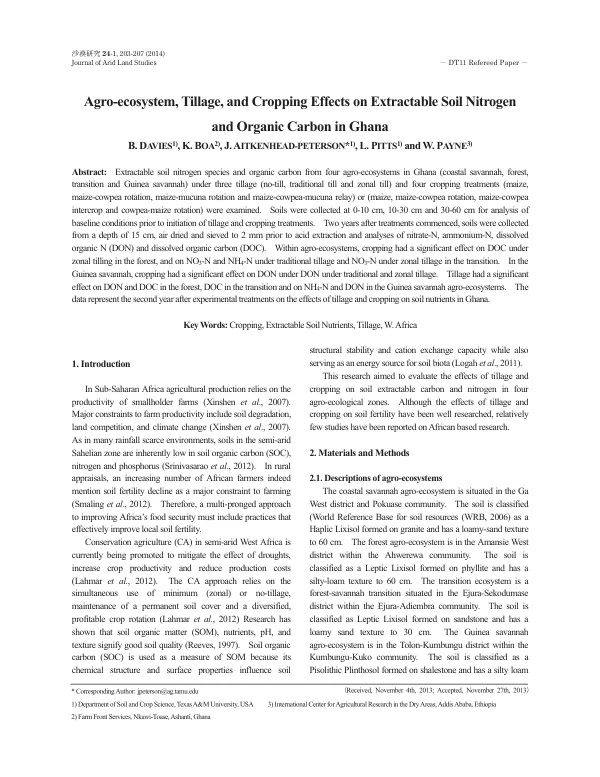
Abstract
The study examined the effects of tillage and cropping on extractable soil nitrogen species and organic carbon. Soils were collected at 0-10 cm, 10-30 cm, and 30-60 cm prior to initiation of tillage and cropping treatments, and again two years later at a depth of 15 cm. The results showed that cropping had a significant effect on dissolved organic carbon (DOC) under zonal tilling in the forest, and on nitrate-N and ammonium-N under traditional tillage and nitrate-N under zonal tillage in the transition. In the Guinea savannah, cropping had a significant effect on dissolved organic nitrogen (DON) under traditional and zonal tillage. Tillage had a significant effect on DON and DOC in the forest, DOC in the transition, and on ammonium-N and DON in the Guinea savannah agro-ecosystems. The study used a split plot design to test the effects of cropping and tillage on soil nutrients. The main plots were no-till, zonal or conservation tillage, and traditional tillage, while the sub-plots were different cropping treatments. Soils were analyzed for percent carbon and nitrogen, and the C:N ratio was estimated. The results showed that the C:N ratio ranged from 10.0 to 5.0 in the coastal savannah, indicating a larger soil pool of N at 30-60 cm depth compared to 0-10 cm depth. The study also examined the effects of tillage and cropping on soil pH, with results showing that soils in the coastal savannah and forest agro-ecosystems were moderately to slightly acidic, while soils in the transition site were very acidic and those in the Guinea savannah site were acidic. The study used univariate analysis of variance to statistically analyze the data and examine the effects of agro-ecosystem, tillage, and cropping across the whole dataset. The results of the study have implications for agricultural development in Ghana, particularly in the context of conservation agriculture. The study suggests that conservation tillage and cropping practices can improve soil fertility and crop productivity, particularly in the forest and transition agro-ecosystems. The study also highlights the importance of considering the effects of tillage and cropping on soil pH and C:N ratio when developing agricultural practices in Ghana.
Related documents