USAID DEC
Sensory Attributes of Three Edible Tropical Mushrooms and Their Use in Formulating Food Products for Children 2-5 Years Old
Sign inUSAID DEC
Sensory Attributes of Three Edible Tropical Mushrooms and Their Use in Formulating Food Products for Children 2-5 Years Old
The study aimed to investigate the sensory attributes of three edible tropical mushrooms and their potential use in formulating food products for children aged 2-5 years.
2018 · 10 pages
Sign in to readA free account is required to download.
Abstract
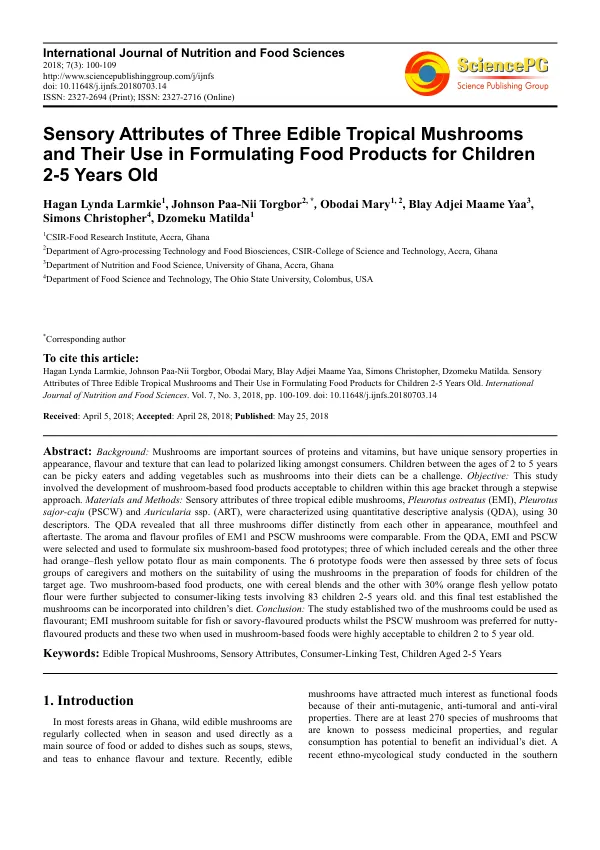
The three mushrooms in question are Pleurotus ostreatus (EMI), Pleurotus sajor-caju (PSCW), and Auricularia ssp. (ART). These mushrooms are known for their unique sensory properties, including appearance, flavor, and texture, which can influence consumer acceptance. Quantitative Descriptive Analysis (QDA) was used to characterize the sensory attributes of the three mushrooms. The analysis revealed that all three mushrooms differ distinctly from each other in appearance, mouthfeel, and aftertaste. The aroma and flavor profiles of EMI and PSCW mushrooms were comparable. Based on the QDA results, EMI and PSCW were selected for further study. Six mushroom-based food prototypes were formulated using EMI and PSCW. Three of the prototypes included cereals, while the other three had orange-flesh yellow potato flour as the main component. The prototypes were then assessed by three sets of focus groups consisting of caregivers and mothers to determine their suitability for use in preparing foods for children aged 2-5 years. The focus group discussions revealed that the mushroom-based food products were generally acceptable to the caregivers and mothers. However, some participants expressed concerns about the texture and flavor of the products. To address these concerns, two mushroom-based food products were further subjected to consumer-liking tests involving 83 children aged 2-5 years. The consumer-liking tests revealed that the mushroom-based food products were highly acceptable to the children. The results showed that EMI mushroom was suitable for fish or savory-flavored products, while PSCW mushroom was preferred for nutty-flavored products. The study concluded that the two mushrooms can be used as flavorants in food products for children aged 2-5 years. The study highlights the potential of edible tropical mushrooms as a nutritious and flavorful ingredient in food products for children. The results suggest that mushrooms can be a valuable alternative to traditional ingredients, particularly in regions where access to nutritious food is limited. The study's findings have implications for the development of mushroom-based food products that are acceptable to children and can contribute to improved nutrition and health outcomes. The sensory attributes of the three edible tropical mushrooms were characterized using QDA, which revealed distinct differences in appearance, mouthfeel, and aftertaste. The aroma and flavor profiles of EMI and PSCW mushrooms were comparable, suggesting that these two mushrooms may be suitable for use in food products. The study's findings have implications for the development of mushroom-based food products that are acceptable to children and can contribute to improved nutrition and health outcomes. The study's results suggest that EMI mushroom is suitable for fish or savory-flavored products, while PSCW mushroom is preferred for nutty-flavored products. The study's findings have implications for the development of mushroom-based food products that are acceptable to children and can contribute to improved nutrition and health outcomes. The use of edible tropical mushrooms in food products can provide a nutritious and flavorful alternative to traditional ingredients, particularly in regions where access to nutritious food is limited.