MERCY CORPS INTERNATIONAL
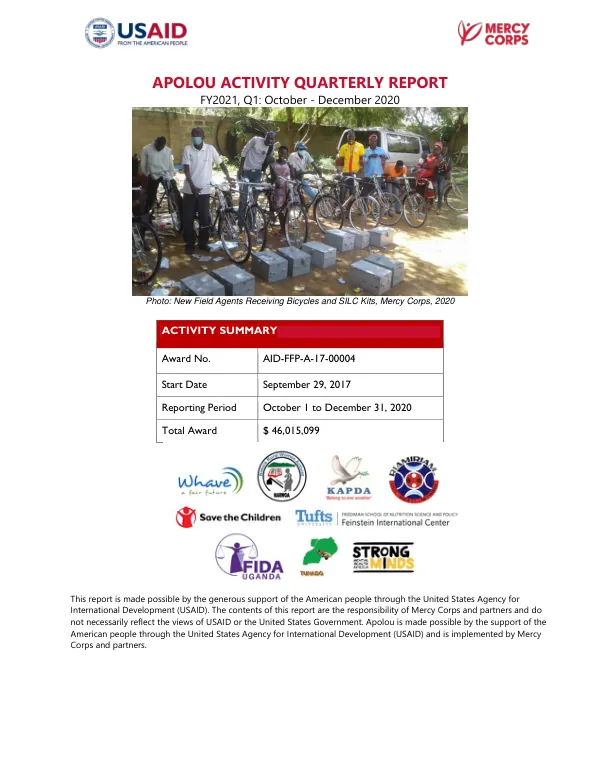
APOLOU ACTIVITY QUARTERLY REPORT FY2021, Q1: October - December 2020
The Apolou Activity is a USAID Food for Peace initiative aimed at improving the food and nutrition security of 310,000 vulnerable households in the Kaabong, Karenga, Kotido, Moroto, and Amudat districts of Karamoja, the most nutritionally vulnerable region in Uganda.
2021 · 15 pages
Sign in to readA free account is required to download.
Abstract
The activity is implemented by a consortium of partners, including Mercy Corps, Save the Children, Whave Solutions, Tufts University's Feinstein International Center, and others. The initiative has four purposes: inclusive and effective governance contributes to food and nutrition security, adolescent girls, pregnant and lactating women, and children under five are nutritionally secure, reduced incidences of water, sanitation, and hygiene-related diseases, and improved livelihoods and income support household food security. The program operates in a challenging context, with increased incidents of cattle raiding and insecurity in the region. The security situation was relatively stable, but the program observed increased theft of animals, which hurts program outcomes. The quarter was also impacted by political election campaigns, which delayed program activities and reduced motivation for contributing to program activities. The program has continued to follow standard operating procedures in response to COVID-19, with minimal impact on implementation. Apolou has restructured its implementation approach, with separate technical and implementation teams. The new structure will increase integration across the purposes and allow Apolou to take on a more facilitative role. The technical team has developed a skeletal work breakdown structure (WBS) for FY21, outlining basic outputs and outcomes. Apolou conducted internal planning meetings in each of its four districts in December to develop an integrated plan for the following quarter. A stakeholder meeting was held on December 1, 2020, in Moroto District, attended by District Local Governments, Resident District Commissioners, and other government participants. The meeting provided updates on Apolou's realignment process and implementation progress, and facilitated discussions around the project transition process to government. The meeting aimed to develop an effective working relationship with states and other authorities. The program has made progress in implementing its activities, including the re-structuring of its implementation approach and the development of an integrated plan for the following quarter. Apolou has also conducted a stakeholder meeting to provide updates on its realignment process and implementation progress. The program continues to face challenges, including increased incidents of cattle raiding and insecurity in the region, but is working to adapt to these challenges and achieve its goals. Apolou's implementation approach is grounded in social behavior change and supporting gender-transformative and resilience outcomes. The program aims to improve the food and nutrition security of 310,000 vulnerable households in the Kaabong, Karenga, Kotido, Moroto, and Amudat districts of Karamoja. The program's four purposes are inclusive and effective governance contributes to food and nutrition security, adolescent girls, pregnant and lactating women, and children under five are nutritionally secure, reduced incidences of water, sanitation, and hygiene-related diseases, and improved livelihoods and income support household food security. The program has established a Resilience Challenge Fund (RCF) to support community-led initiatives and activities that promote resilience and improve food and nutrition security. The RCF has provided funding for community-led initiatives, including the establishment of savings and internal lending communities (SILC) and the promotion of agricultural practices. The program has also established a monitoring, evaluation, and learning (MEL) system to track progress and identify areas for improvement. Apolou's implementation approach is guided by a detailed implementation plan, which outlines the program's activities, outputs, and outcomes. The plan is regularly reviewed and updated to reflect changes in the program's context and to ensure that the program is on track to achieve its goals. The program's implementation approach is also guided by a sustainability and exit strategies plan, which outlines the program's plans for transitioning to government ownership and ensuring the long-term sustainability of the program's activities. The program has established a strong partnership with local government authorities, including the District Local Governments and the Resident District Commissioners. The program has also established partnerships with other stakeholders, including the Uganda National Apiculture Development Organisation (TUNADO) and the Karamoja Peace and Development Agency (KAPDA). These partnerships are critical to the program's success, as they provide access to local knowledge, expertise, and resources. Apolou's implementation approach is grounded in a deep understanding of the local context and the needs of the target population. The program has conducted extensive research and analysis to identify the key drivers of food and nutrition insecurity in the region and to develop a program that addresses these drivers. The program's activities are designed to be context-specific and to address the unique needs and challenges of the target population. The program has established a strong monitoring and evaluation system to track progress and identify areas for improvement. The system includes a range of indicators, including food security, nutrition, and income, as well as indicators related to the program's four purposes. The program's MEL system is designed to provide regular updates on the