CNFA, INC.
Quarterly Report: Amalima Loko Resilience Food Security Activity
The Amalima Loko program is a 5-year Resilience Food Security Activity implemented by CNFA in partnership with the Organization of Rural Associations for Progress (ORAP), Dabane, Mercy Corps, International Medical Corps (IMC), and The Manoff Group.
2021 · 11 pages
Sign in to readA free account is required to download.
Abstract
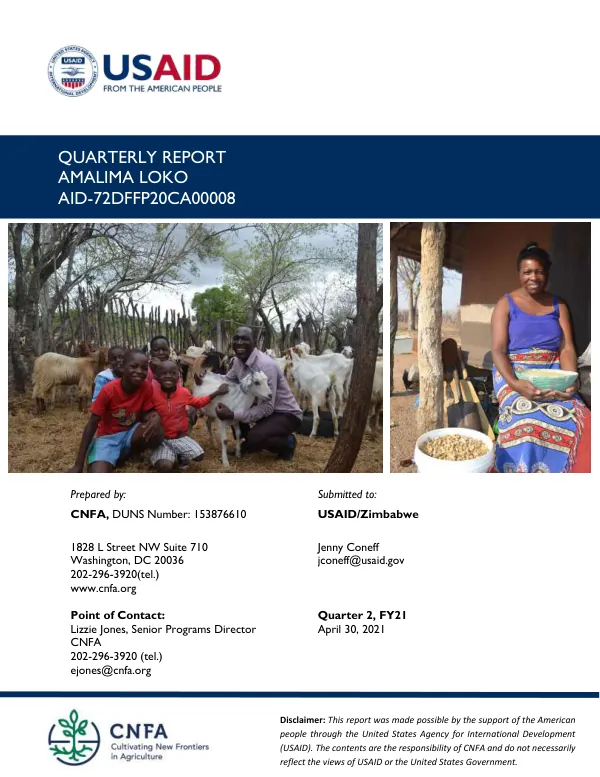
The program aims to improve food and nutrition security for over 67,000 vulnerable households in rural Zimbabwe through increased food access and sustainable watershed management. The program operates in 87 wards across Tsholotsho, Nkayi, Lupane, Binga, and Hwange districts of Matabeleland North province. The program began on September 30, 2020, and the second quarter of FY21 report covers the period from January to March 2021. During this time, the Amalima Loko consortium of partners, led by CNFA, oriented at least 100 team members on Amalima Loko technical and cross-cutting approaches as well as operational compliance. The Collaboration, Learning and Adaptation (CLA) Lead began work in March, and the Amalima Loko team made substantial progress in developing scopes of work (SOWs) and protocols for Refine and Implement (R&I) studies and pilots, recruiting for R&I study consultants, and drafting a year 1 work plan. The program has made progress during this period, protecting the health and safety of staff through a combination of remote working, limited traveling with safety protocols in place, and limiting capacity in the Bulawayo office. The COVID-19 pandemic has had a significant impact on Zimbabwe and globally, with infection and death rates spiking in January 2021 and then declining rapidly. Vaccines became available to the public in late March, although uptake has been slow and vaccine skepticism is widespread. In the broader context, after two years of drought, the whole of Matabeleland North saw very heavy and consistent rains through March 2021, and the upcoming cereal harvest is expected to be above average. Surface water sources and vegetation levels are well above previous years. FEWS Net expects most rural areas to be in IPC Phase 1 by May. The economic situation remains precarious but has been less volatile, with relative stability of the Zimbabwean dollar against the US dollar, and relatively more cash circulating. Annualized inflation remains in triple digits, although it has reduced to less than half of mid-2020 rates. During the second quarter, Amalima Loko technical, operational, and HQ staff compiled the FY21 workplan, which was submitted to USAID on March 11th and approved. The workplan highlights key R&I approaches and activities to be undertaken during the year. Amalima Loko staff participated in a series of inception workshops facilitated by the Bureau for Humanitarian Assistance’s (BHA) Program Cycle Support team to identify information gaps in the Theory of Change (ToC). The workshops included the Gender, Youth, and Social Dynamics (GYSD) workshop, Purpose 1 - Resilience/Community Engagement, Purpose 2 - Watershed Management, Purpose 3 - Health & Livelihoods, and Troubleshooting Gap Consolidation/Prioritization Process for each respective purpose. Information gaps were used to start developing a series of R&I research SOWs (external consultant-led) and protocols (Amalima Loko staff-led studies and pilots) for USAID approval. The SOWs and protocols lay out the context, research objectives, primary info gap research questions, and data collection methodology for each respective study. The R&I studies address priority information gaps that the Amalima Loko team and BHA identified and agreed on in the Inception Workshops. Amalima Loko completed geographic information system (GIS) and Remote Sensing desk studies for all ten Phase 1 clusters, which included soil erosion surveys, land-use maps, and geologic maps. The GIS and Remote Sensing studies identified clusters with the highest erosion risk, rivers, and micro-catchments, as well as community assets of interest such as dams and vleis. The studies also identified villages, schools, and health centers within the micro-catchments and generated water and asset potential maps. Throughout the second quarter, Amalima Loko staff participated in a variety of internal workshops/trainings to orient and build the capacity of fellow program staff on technical approaches and interventions. These included gender orientation, a program meeting to enhance understanding of the ToC, trainings on the program’s resilience approach, social behavior change (SBC) principles, and M&E planning. The Health and Nutrition Team Lead led a 4-day training for Health and Nutrition Field Officers to understand the program’s Sub-Purposes, linkages with other purposes and cross-cutting pillars, and draft the year one work plan. Operations/finance/human resources staff participated in a two-day compliance training covering CNFA operating procedures, procurement, cost principles, and financial reporting. Project staff received introductory training in required environmental compliance, climate risk management, and reporting, including
Related documents