SOCIAL IMPACT, INC.
Applied Political Economy Analysis of USAID Priority Provinces in Indonesia
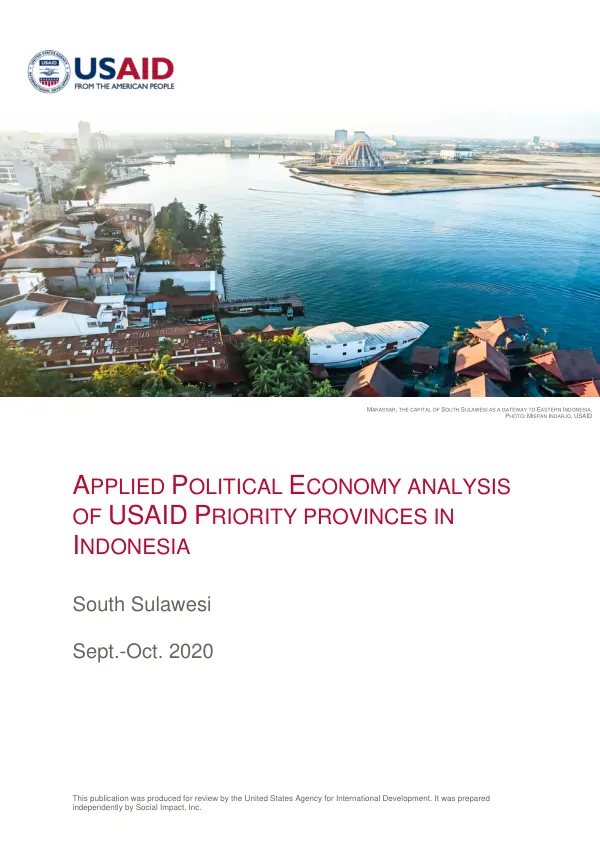
The applied political economy analysis of USAID priority provinces in Indonesia focuses on South Sulawesi.
2021 · 52 pages
Sign in to readA free account is required to download.
Abstract
The study aims to produce operationally relevant findings and implications to inform project/activity design for the upcoming Country Development and Cooperation Strategy (CDCS). The CDCS goal is to make Indonesia an advanced, just, prosperous, and self-reliant Indo-Pacific partner. To achieve this goal, the Government of Indonesia (GOI) has identified four priority areas for USAID support: government effectiveness, human capital development, inclusive economic growth, and environmental sustainability. The study uses the political economy analysis (PEA) framework as a structured approach for examining why things work the way they do. It examines the power dynamics, economic forces, and social forces that influence development effectiveness and analyzes findings according to four pillars: Foundational Factors, Rules of the Game, Here and Now, and Dynamics. The study combines contextual review, desk review, and fieldwork (structured stakeholder interviews) for the analysis. Key findings from the stakeholder discussions highlight the importance of intergovernmental coordination. Despite decentralization being regulated under Law 23/2014, the national level government holds more power and authority than the provincial government, especially in determining development priorities. There is a potential conflict between the decentralization law and the sectoral law due to a conflict of interest and authority in addressing essential service needs at the local level. Musrenbang, a bottom-up approach expected to accommodate discussion between stakeholders in determining development priorities, is deemed ineffective, and there is often a disconnect between national, provincial, and district level development priorities. The study also examines governance, accountability, and service delivery. Governance and accountability are critical for effective service delivery, but the current system is often ineffective in addressing the needs of local communities. The study highlights the importance of inclusive market-driven economic growth, which is critical for reducing poverty and improving living standards. However, the current economic growth model is often unsustainable and has negative impacts on the environment. The study identifies several challenges and opportunities for USAID to support the GOI's priorities. The challenges include the need to strengthen intergovernmental coordination, improve governance and accountability, and promote inclusive economic growth. The opportunities include the potential for USAID to support the GOI's priorities through the CDCS development objectives (DOs): DO 1: Effective, Democratic Governance Strengthened, DO 2: Inclusive Market-Driven Economic Growth Increased, DO 3: Environmental Sustainability Improved, and DO 4: Priority Health Outcomes Improved. The study provides several recommendations for USAID to support the GOI's priorities. These recommendations include strengthening intergovernmental coordination, improving governance and accountability, and promoting inclusive economic growth. The study also highlights the importance of donor coordination and the need for USAID to work closely with other donors to support the GOI's priorities. Overall, the study provides a comprehensive analysis of the political economy of South Sulawesi and highlights the importance of intergovernmental coordination, governance, accountability, and inclusive economic growth for effective development outcomes. The study provides several recommendations for USAID to support the GOI's priorities and promote sustainable development in South Sulawesi.