ABT ASSOCIATES
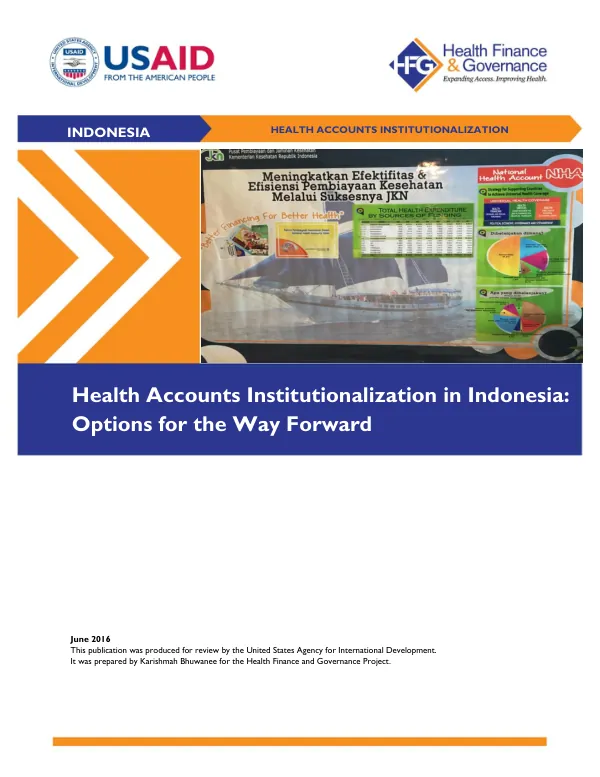
Health Accounts Institutionalization in Indonesia: Options for the Way Forward
Health Accounts Institutionalization in Indonesia: Options for the Way Forward began in 2016 with the support of the USAID-funded Health Finance and Governance project (HFG).
2016 · 26 pages
Sign in to readA free account is required to download.
Abstract
The project aimed to improve health in developing countries by expanding people's access to healthcare. HFG worked with partner countries to increase their domestic resources for health, manage those resources more effectively, and make wise purchasing decisions. The HFG project was led by Abt Associates and had a five-year budget of $209 million. The project's goal was to increase the use of both primary and priority health services, including HIV/AIDS, tuberculosis, malaria, and reproductive health services. The project was designed to fundamentally strengthen health systems, supporting countries as they navigated economic transitions needed to achieve universal healthcare. In Indonesia, Health Accounts have been produced by the University of Indonesia's School of Public Health in conjunction with the Ministry of Health (MOH) over the past decade. However, as of 2016, funding from Australia's Department of Foreign Affairs and Trade (DFAT) ended, and the MOH is now considering options for institutionalizing Health Accounts within the MOH's Center for Health Financing and Health Security (PPJK). The USAID-funded HFG project was asked to support PPJK in considering the potential ways to institutionalize Health Accounts and the technical and human resource capacity that would be needed. HFG conducted meetings with key stakeholders, including PPJK, the University of Indonesia, USAID, and WHO, to understand the current Health Accounts process in Indonesia, previous successes and challenges, and stakeholder perspectives on how Health Accounts production and use could be more regular and effective. The framework for Health Accounts institutionalization was developed by the World Bank's Technical Advisory Group for Health Accounts, comprising members from the World Bank, OECD, WHO, USAID, and the Bill and Melinda Gates Foundation. The framework defines complete Health Accounts institutionalization when countries have institutionalized four key elements: demand for Health Accounts and use of Health Accounts results, sustainable production, effective dissemination, and combination of Health Accounts data with other datasets to conduct in-depth policy-relevant analysis. The framework emphasizes a cycle that is regularly repeated to inform the national planning process. It defines institutionalization as the "routine government-led and country-owned production and utilization of an essential set of policy-relevant health expenditure data using an internationally accepted health accounting framework." In addition to this framework, HFG also incorporated recommendations from WHO shared during their recent training workshops on the roll-out and institutionalization of the Systems of Health Accounts (SHA) 2011. The institutionalization of Health Accounts in Indonesia is crucial for the country's health planning and budgeting processes. The PPJK is considering options for institutionalizing Health Accounts production, dissemination, and use, including resource requirements and steps that would be needed. The next chapter describes options for PPJK-led Health Accounts production from 2016, including resource requirements, and options for institutionalizing Health Accounts production, dissemination, and translation/use. The institutionalization of Health Accounts in Indonesia will require a sustained effort from the MOH, PPJK, and other stakeholders. It will also require significant technical and human resource capacity to ensure the production, dissemination, and use of Health Accounts data. The framework for Health Accounts institutionalization provides a comprehensive guide for the institutionalization process, and the recommendations from WHO and other stakeholders will be crucial in informing the way forward for the MOH and PPJK.