USAID DEC
Applying the HRH Action Framework to Develop Sustainable Excellence in the Health Supply Chain Workforce
Sign inINTRAHEALTH
Applying the HRH Action Framework to Develop Sustainable Excellence in the Health Supply Chain Workforce
The health supply chain workforce plays a crucial role in ensuring that medicines and other health commodities reach the people who need them, contributing to improved health outcomes.
2013 · 6 pages
Sign in to readA free account is required to download.
Abstract
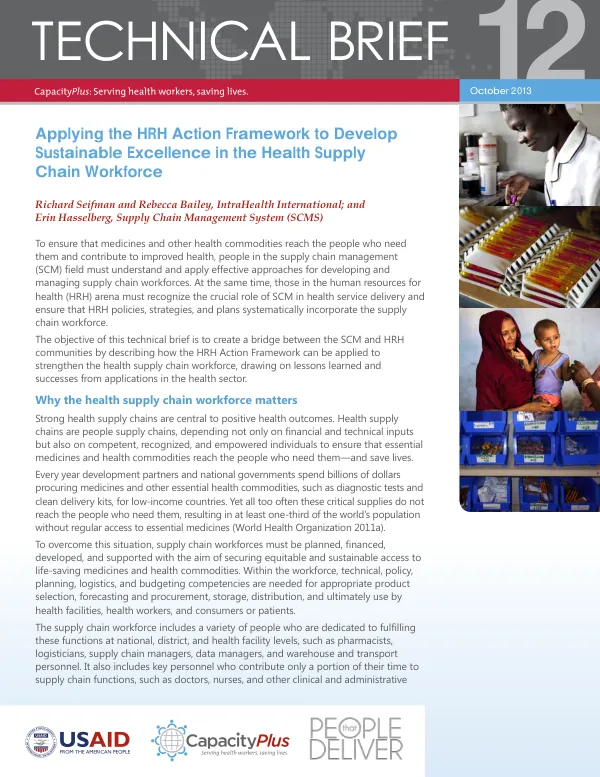
Strong health supply chains are central to positive health outcomes, and they depend on competent, recognized, and empowered individuals to ensure that essential medicines and health commodities reach the target population. Every year, development partners and national governments spend billions of dollars procuring medicines and other essential health commodities for low-income countries, yet these critical supplies often do not reach the people who need them, resulting in at least one-third of the world's population without regular access to essential medicines. The supply chain workforce includes a variety of people who are dedicated to fulfilling functions at national, district, and health facility levels, such as pharmacists, logisticians, supply chain managers, data managers, and warehouse and transport personnel. It also includes key personnel who contribute only a portion of their time to supply chain functions, such as doctors, nurses, and other clinical and administrative staff. These individuals function within a coordinated system to provide appropriate, effective, and affordable medicines and commodities. The HRH Action Framework (HAF) is an approach for planning, developing, and managing the health workforce. The HAF can be used to guide stakeholders in various sectors toward the application of strategies to achieve an effective and sustainable health workforce. The framework has been used successfully in many countries to address systemic challenges in the general health workforce. For example, Uganda improved its HRH Strategic Plan 2005-2020 by applying a comprehensive HAF approach that led to interventions and significant funding for health workforce strengthening from the national budget and the World Bank. The HRH Action Framework action cycle involves implementing an HRH situational analysis using tools developed by the World Health Organization and others; applying the results of the situational analysis for strategy and operational workforce planning; identifying implementation and supervision responsibilities; and establishing routine monitoring and evaluation systems for the health workforce. To facilitate the situational analysis for the supply chain workforce, the USAID | DELIVER Project and the People that Deliver initiative developed an assessment guide and tool to provide a rapid, comprehensive assessment of the capacity of the human resources support system for a country's supply chain. Within the HAF's action field of human resources management systems, there are three management areas of key importance: HRH information; workforce planning; and performance management and retention. Effective HRH management generally, and for the health supply chain in particular, requires an information system that provides reliable data to plan for necessary staff, train, appraise staff performance, and provide salaries and incentives for their retention. Many countries use or are planning to use human resources information systems that track the number, posting, and staffing gaps of health workers. However, existing systems seldom include data on nonclinical and support workforce personnel who are critical to the supply chain. Achievable activities for strengthening the health supply chain workforce include SCM and HRH personnel jointly gathering available data on SCM staff to systematically incorporate the data into human resources information systems; estimating staffing needs and reviewing SCM staffing plans for public health facilities at national, district, and health facility levels of the health system; and providing clear career paths with financial and nonfinancial incentives and career development opportunities based on performance, as well as adequate workplace environments and working conditions.