FOOD AND AGRICULTURAL ORGANIZATION
USAID MTaPS I GHSA AMR Technical Program Update
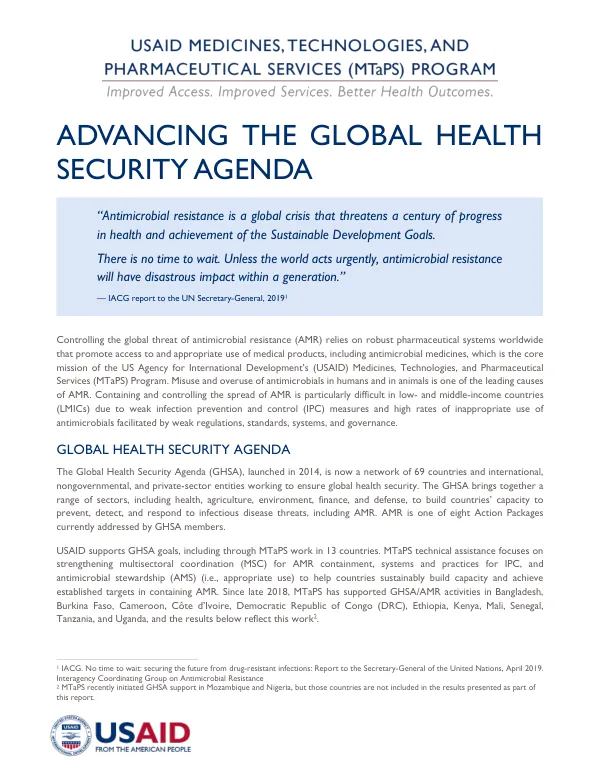
The Global Health Security Agenda (GHSA) is a network of 69 countries and international, nongovernmental, and private-sector entities working to ensure global health security.
2020 · 16 pages
Sign in to readA free account is required to download.
Abstract
Launched in 2014, the GHSA brings together a range of sectors, including health, agriculture, environment, finance, and defense, to build countries' capacity to prevent, detect, and respond to infectious disease threats, including antimicrobial resistance (AMR). AMR is one of eight Action Packages currently addressed by GHSA members. The US Agency for International Development's (USAID) Medicines, Technologies, and Pharmaceutical Services (MTaPS) Program supports GHSA goals, including through work in 13 countries. MTaPS technical assistance focuses on strengthening multisectoral coordination (MSC) for AMR containment, systems and practices for infection prevention and control (IPC), and antimicrobial stewardship (AMS) to help countries sustainably build capacity and achieve established targets in containing AMR. Since late 2018, MTaPS has supported GHSA/AMR activities in Bangladesh, Burkina Faso, Cameroon, Côte d'Ivoire, Democratic Republic of Congo (DRC), Ethiopia, Kenya, Mali, Senegal, Tanzania, and Uganda. The GHSA uses the World Health Organization (WHO) Joint External Evaluation (JEE) tool to measure country capacity in 19 technical areas, including AMR. In 2019, WHO released Benchmarks for International Health Regulations Capacities, a complementary tool to help countries identify and implement recommended actions to make progress in the JEE technical areas. MTaPS' goal is to help its 13 GHSA countries improve capacity to advance to higher JEE levels in MSC, IPC, and AMS using the WHO benchmarks and JEE tool to measure progress. MTaPS' technical approach is to base country implementation plans on the findings from MTaPS' scoping visits, the countries' baseline JEEs, and guidance from the WHO benchmarks tool. The approach also involves collaborating with partners at the global, regional, and country levels and embedding monitoring and knowledge sharing to capture, document, and disseminate experiences and results. In addition to working at the national level, as of September 2020, MTaPS is providing direct support to 86 health facilities to strengthen IPC and AMS practices. To help supported GHSA countries, MTaPS drafted six 'how-to' mini-guides to help standardize planning, jump-starting, and implementing a select set of activities that countries identify as priorities. These activities include classifying essential medicines list antibiotics into AWaRe categories, implementing a continuous quality improvement approach to strengthen IPC programs, and assessing IPC status using WHO's national-level and facility-level tools. The MTaPS GHSA work supports additional global initiatives, including those related to universal health coverage, sustainable development goals, and healthcare quality improvement. AMR cannot be overcome without addressing all of its drivers, which span the human, animal, plant, and environmental sectors. The One Health approach, with MSC at its core, provides the mechanisms for countries to successfully implement their multisectoral national action plans on AMR, including strengthening IPC and AMS practices in both human and animal health. MTaPS works with country counterparts on strengthening leadership and governance functions or technical capacity of the multisectoral coordination body, helping to set up or improve the functioning of technical working groups on IPC and AMS, and supporting the development and updating of governance documents. MTaPS presented Effective multisectoral coordination on AMR: a landscape of experiences and lessons from 11 countries at a side event organized around the 6th GHSA Ministerial Meeting on November 4, 2020. The presentation highlighted the importance of MSC in addressing AMR and the need for countries to work together to contain the spread of AMR.
Related documents