USAID DEC
Aragats stratovolcano in Armenia - volcano-stratigraphy and petrology
Aragats stratovolcano in Armenia is a prominent volcanic feature situated in the NE part of the Anatolian-Armenian-Iranian plateau, an intensely deformed segment of the Alpine-Himalayan belt.
2014 · 1 pages
Sign in to readA free account is required to download.
Abstract
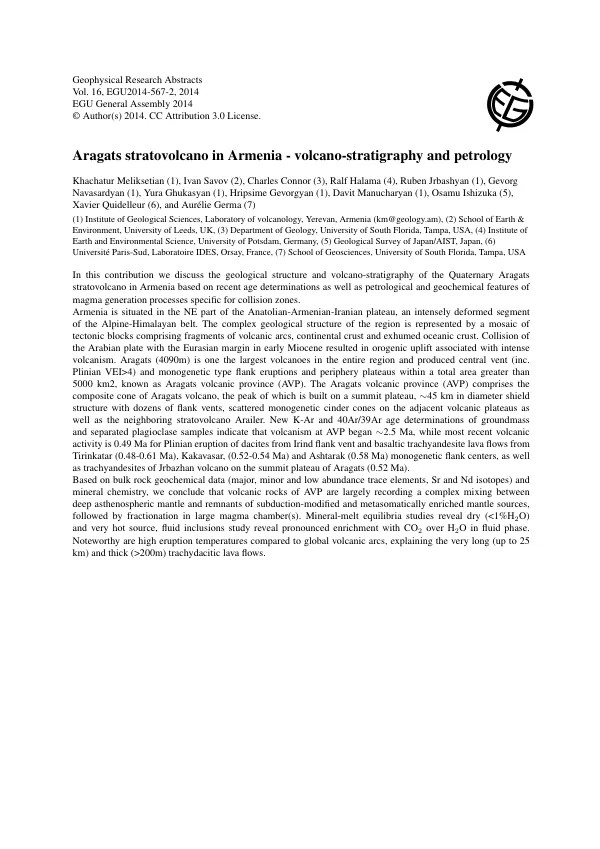
The region's complex geological structure is represented by a mosaic of tectonic blocks comprising fragments of volcanic arcs, continental crust, and exhumed oceanic crust. Collision of the Arabian plate with the Eurasian margin in early Miocene resulted in orogenic uplift associated with intense volcanism. Aragats (4090m) is one of the largest volcanoes in the region and produced central vent and monogenetic type flank eruptions and periphery plateaus within a total area greater than 5000 km2, known as the Aragats volcanic province (AVP). The AVP comprises the composite cone of Aragats volcano, the peak of which is built on a summit plateau, ∼45 km in diameter shield structure with dozens of flank vents, scattered monogenetic cinder cones on the adjacent volcanic plateaus, as well as the neighboring stratovolcano Arailer. New K-Ar and 40Ar/39Ar age determinations indicate that volcanism at AVP began ∼2.5 Ma, while most recent volcanic activity is 0.49 Ma for Plinian eruption of dacites from Irind flank vent and basaltic trachyandesite lava flows from Tirinkatar, Kakavasar, and Ashtarak monogenetic flank centers, as well as trachyandesites of Jrbazhan volcano on the summit plateau of Aragats (0.52 Ma). Bulk rock geochemical data and mineral chemistry reveal that volcanic rocks of AVP are largely recording a complex mixing between deep asthenospheric mantle and remnants of subduction-modified and metasomatically enriched mantle sources, followed by fractionation in large magma chamber(s). Mineral-melt equilibria studies indicate a dry (<1%H2O) and very hot source, while fluid inclusions studies reveal pronounced enrichment with CO2 over H2O in the fluid phase. Noteworthy are high eruption temperatures compared to global volcanic arcs, explaining the very long (up to 25 km) and thick (>200m) trachydacitic lava flows. The geological structure and volcano-stratigraphy of Aragats stratovolcano are characterized by a complex interplay of tectonic and magmatic processes. The volcano's evolution is closely tied to the regional tectonic setting, with the collision of the Arabian plate with the Eurasian margin driving orogenic uplift and intense volcanism. The AVP is a unique example of a large volcanic province formed in a collision zone, with a complex geological structure and petrological features that reflect the interaction of deep mantle and subduction-modified mantle sources. The study of Aragats stratovolcano provides valuable insights into the geological evolution of the region and the processes that shape volcanic provinces in collision zones. The findings of this study have implications for our understanding of the complex interactions between tectonic and magmatic processes in these regions, and highlight the importance of continued research into the geological history and petrology of volcanic provinces.
Related documents